Most families decide on a community during the tour, not on the phone and not on your website. A great senior living tour feels like a visit with people who already know them. A forgettable one feels like a walk past rooms that look like every other building they saw this week.
This guide walks sales teams through the whole thing: confirming the visit, preparing, greeting, discovery, the route, the meal, the price talk, the next step and the follow-up. There’s also a tour-prep checklist you can print and use before every visit.
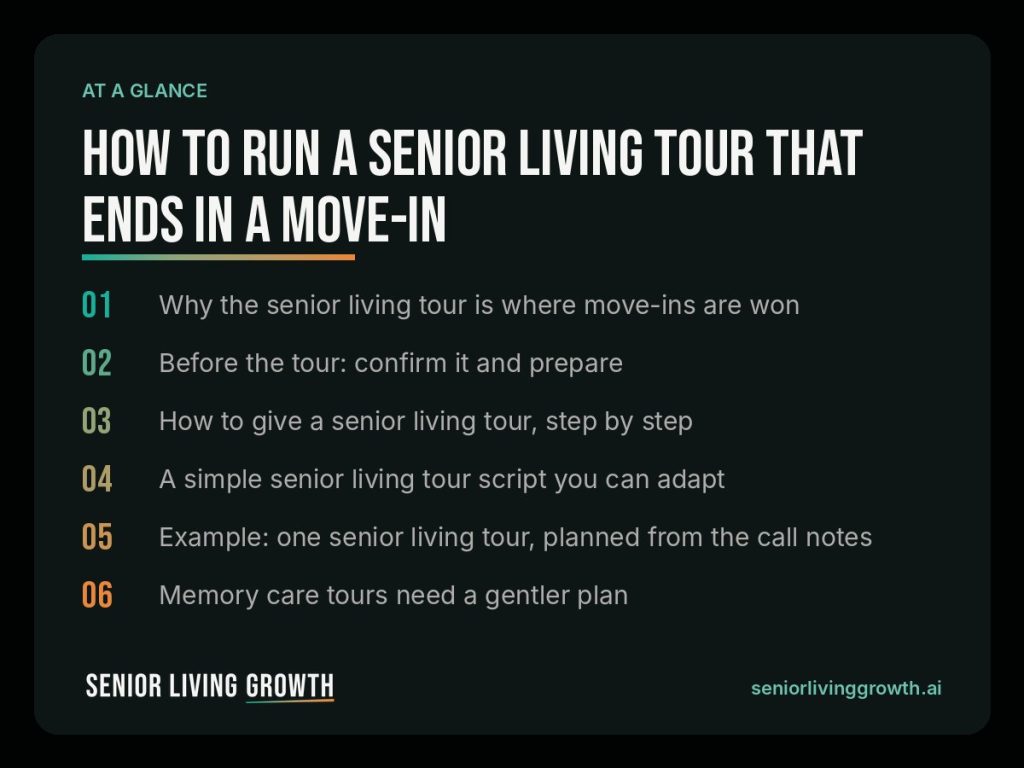
Why the senior living tour is where move-ins are won
By the time a family walks in, they’ve usually read your reviews and looked at your photos. What they came to find out is something photos can’t show them: will Mom be safe here, will she be happy, and do these people actually care?
That’s why I tell every new counselor the same thing. The tour is not about your building. It’s about one person’s next chapter, and your job is to help the family picture it clearly.
Families also tour more than one place. Your community has to be the one they remember on the drive home, and the one that makes the next step feel easy.
Before the tour: confirm it and prepare
Confirm the visit with two reminder texts
No-shows hurt, and many of them are simply people who forgot or got busy. A text the day before and another one hour before cuts that down. Always include an easy way to reschedule, because a family who can tell you they can’t make it isn’t a no-show. They’re a reschedule.
You can copy our Two Reminder Texts template word for word and fill in the blanks.
Prepare from what you learned on the call
Your first call or inquiry gave you clues. Go back to your notes and pull out the details that matter: who the tour is for, who’s coming, what worries them most, and what their loved one loves to do.
If Dad was a woodworker, find out if your community has a workshop or a resident who builds birdhouses. If Mom’s daughter mentioned falls at night, be ready to show call systems and talk about night staffing. Preparing this way is what turns a standard walk-through into a personal one.
Your tour-prep checklist
Run through this list the day before or the morning of every tour:
- Both reminder texts are scheduled or sent.
- Your call notes are reviewed: who’s coming, the loved one’s name, their main worry and their interests.
- You know the likely care level (independent, assisted living or memory care) and roughly what it costs.
- The apartment or room you’ll show is clean, open, bright and set at a comfortable temperature.
- One or two team members who connect to their interests know when you’ll stop by.
- A resident who enjoys meeting visitors has agreed to say hello, if possible.
- A meal, snack or activity is planned, and the kitchen knows you’re coming.
- Your route is planned around what matters to this family, not the standard path.
- Pricing sheets and a simple next-steps sheet are ready to hand over.
- A quiet room is ready for the sit-down, with water or coffee.
- Someone is covering your phone so you’re not interrupted.
- Your calendar has open times you can offer for the next step.
How to give a senior living tour, step by step
1. Greet them like guests, not leads
Be at the door when they arrive. Use everyone’s name, including the loved one’s, and speak directly to the senior, not just the adult child. Offer a drink and a seat. First impressions start in the parking lot and the lobby, so make sure both feel calm and welcoming.
2. Sit down first for discovery
The biggest mistake I see is starting the walk right away. Sit down for ten or fifteen minutes first. Ask open questions and let them talk:
- “What’s a normal day like for your mom right now?”
- “What made you start looking now?”
- “What worries you most about the next few months?”
- “What does she enjoy most? What would make her smile here?”
- “Who else will be part of this decision?”
Listen more than you talk. Write down their exact words. You’ll use them on the tour, in the price talk and in your follow-up.
3. Personalize the route
Once you know what matters, change the route to match. A family worried about safety should see the call system and meet a caregiver. A man who loves to garden should see the raised beds before he sees the theater room.
Skip rooms that don’t matter to them. A shorter tour that hits their real concerns beats a long tour that shows everything. Point back to what they told you: “You mentioned she loves to play cards. This is where the Tuesday group meets.”
4. Let staff and residents do the talking
Families trust caregivers and residents more than they trust sales people. Introduce the nurse, the activities director or the chef by name. If a resident is happy to chat, let them share what they like about living there. Those short moments often do more than anything you say.
5. Share a meal or an activity
Food is personal, and dining is a big part of daily life. Invite them to eat with you, or at least try something from the kitchen. If a meal won’t work, drop into an activity for a few minutes. The goal is for the senior to feel what a normal day is like, not just see it.
6. Handle questions and price honestly
Families arrive with questions, and many bring printed checklists. They’ll ask about staffing, care plans, what happens if needs change, and what’s included in the monthly cost. Answer clearly. If you don’t know, say so and promise to find out by a set time.
Talk about price plainly. Explain what the base rate covers, how care costs are figured, what extra fees exist and how rate increases usually work. Hiding costs until later breaks trust, and trust is the whole sale.
Pay attention to which questions come up on every tour. Those same questions belong on your website, so families get answers before they ever call. Our Questions to Answer First list is a good place to start.
When they raise a concern, don’t rush to argue. Repeat it back, ask a question to understand it, then answer. “So the cost feels high compared to staying home. Can I ask what you’ve been comparing it to?” opens a real conversation.
7. Agree on a clear next step before they leave
Never end a tour with “Let me know if you have questions.” End it with a specific next step and a date. That could be:
- A second visit for lunch with the loved one.
- A care assessment with your nurse.
- A call with another family member who couldn’t come.
- Holding an apartment while they decide.
Put it on the calendar while you’re still sitting together. A next step booked in person is far easier to keep than one you have to chase by phone later.
A simple senior living tour script you can adapt
Scripts sound stiff when you read them word for word. Use this one as a guide for the key moments of a senior living tour, then put it in your own words.
At the door
“Hi, you must be [daughter’s name], and this must be [Mom’s name]. I’m so glad you’re both here. Come on in. Let’s grab a coffee and sit down for a few minutes before we walk around.”
Moving from the sit-down to the walk
“Thank you for sharing all of that. You said nights are the hardest right now and that she misses her card games. So I’d like to start with how our night caregivers work, and then stop by the card room. Does that sound good?”
That one sentence tells the family you listened. It also gives them a say in the plan, which helps everyone relax.
During the walk
Tie each stop back to their words, and ask a small question at each stop:
- “Can you picture her favorite chair right by this window?”
- “Is this the kind of room she’d want to spend time in?”
- “What do you think she’d say about the dining room?”
Their answers tell you what’s working and what isn’t, while there’s still time to show something else.
Before the price talk
“Before we look at numbers, what questions are on your mind? I’d rather answer the hard ones now than have you wondering on the drive home.”
Asking for the next step
“Most families like to come back once before they decide, often for lunch so [Mom’s name] can meet a few people. I have Tuesday at noon or Thursday at noon open. Which works better for you?”
Two clear choices make saying yes easy. If neither works, ask what would, and book it before anyone stands up.
When they say “We’re just looking”
“That makes total sense. Most people visit a few places. What would you need to see to know a place is the right fit?”
Their answer becomes your follow-up plan. Write it down word for word.
Example: one senior living tour, planned from the call notes
Here’s a made-up example to show how the pieces fit together. The family and the details are invented for teaching only.
What the call notes said: A daughter called about her father, who lives alone. He has fallen twice this year, he has stopped cooking for himself, and he spent most of his life as a high school band teacher. She’s worried he’ll refuse to move. Her brother lives out of state and wants a say in the decision.
How the counselor planned the visit:
- Sent both reminder texts and offered a video call link so the brother could join the sit-down.
- Asked the activities director when the music group meets and timed the visit so they could drop in.
- Asked a resident who plays piano if he’d be happy to say hello.
- Planned the route: the sit-down first, then the call system and a caregiver who works nights, then lunch, then the music room.
- Skipped the fitness room and the theater, since neither came up on the call.
How the visit would close: Instead of “Let me know,” the counselor offers a second visit on the day the music group meets, with the brother joining by video. The father now has a reason to come back that has nothing to do with his falls.
Notice what drove every choice: the family’s own words. That’s the whole idea behind a personal senior living tour.
Memory care tours need a gentler plan
A memory care tour is often harder on families. Many are tired, grieving and feeling guilty. Slow down, keep the group small, and give them time to ask hard questions about safety, secured doors, staff training and what a day looks like.
Ask before you include the person living with dementia in every part of the tour. Some families want them there. Others want to visit alone first so they can talk openly. Follow their lead.
Show real moments, not just spaces: a music group, a staff member gently redirecting a resident, the outdoor area people can safely use. Families want proof that their loved one will be known and treated with dignity.
When the senior doesn’t want to be there
Many seniors come on a senior living tour because their kids asked them to, not because they want to move. Some will say it out loud: “I’m only here to make my daughter happy.” That’s not a lost cause. It’s honest, and you can work with honest.
- Don’t sell to them. Talk with them. Ask about their life, their home and what they’d miss most. People soften when they feel heard.
- Give them control. Let them choose where to go next, or whether to stop for coffee. Moving can feel like losing control, so small choices matter.
- Don’t take sides. If the family starts to argue, stay calm and kind. Your job is to help everyone see the options, not to win the argument.
- Lower the stakes. Invite them to a lunch or an event, not a decision. “Come for Friday’s concert, no strings attached” is much easier to accept than “Come live here.” If your community offers short stays, mention them as a way to try it out.
A senior who leaves feeling respected may come back on their own terms. One who feels pushed usually won’t.
Follow up the same day
The tour isn’t over when the car pulls away. Send a short, warm thank-you message the same day. Answer one question they asked, confirm the next step, and give them your direct number.
Before you send anything, take five minutes to write your notes while the senior living tour is still fresh in your mind:
- Who came, and who else will help decide
- Their exact words about worries and wishes
- What they liked and what fell flat
- Questions you promised to answer, and by when
- The next step and its date
Those notes make every follow-up message personal. They also let a teammate pick up the lead if you’re ever out sick.
Then keep going. A helpful message on day three and a check-in on day seven keep you on their mind without pressure. Our Three Post-Tour Messages give you all three, ready to copy. A useful thing to send on day three is our assisted living move-in checklist, which helps families see what the move will really involve.
Follow-up is where many communities fall short. Families often tour several places, and the one that stays in touch with something helpful is often the one they choose. Don’t let a great tour die in your inbox.
Common assisted living tour mistakes to avoid
- Skipping discovery. Walking first and asking later means you show the wrong things.
- Talking to the adult child only. The senior is the one moving. Speak to them first.
- Showing every room. More is not better. Relevant is better.
- Dodging price. Families notice, and it makes them wonder what else you’re hiding.
- Ending without a date. “Call me when you’re ready” usually means you won’t hear back.
- Slow follow-up. A message the next week feels like an afterthought.
If you want to sharpen these skills across your whole team, our guide to senior living sales training covers how to practice discovery, objections and follow-up. For a bigger-picture view of how the tour fits into the full sales cycle, see this guide to the senior living sales process from Pathly CRM.
Bring it all together
A senior living tour that ends in a move-in is planned, personal and honest. Confirm it, prepare from your notes, sit down before you walk, show what matters to this family, let your people shine, and leave with a date on the calendar. Then follow up before the day is over.
You don’t have to write the texts from scratch. Grab the reminder texts, post-tour messages and more on our free templates page. They’re free to use and share with your team.
Keep reading
- How to Build a Resident Referral Program That Works
- How to Build a Senior Living Marketing Plan (Free Template)
- How to Succeed in Senior Living Sales (and Land the Job)
- More sales guides on the blog
FAQ
How long should a senior living tour last?
Plan on about an hour, including a sit-down for discovery at the start. If you share a meal or join an activity, it may run closer to 90 minutes. Let the family set the pace, and keep the walk focused on what matters to them.
What should be on an assisted living tour checklist for sales teams?
Confirm the visit with reminder texts, review your call notes, prepare the room you’ll show, and give staff and a resident a heads-up. Plan a meal or activity, have pricing ready, and block times on your calendar for the next step. The full checklist above covers every item.
Should the senior come on the tour?
Whenever possible, yes, because they’re the one who will live there and their buy-in matters. Some families prefer to visit alone first, especially for a memory care tour. Ask what they’d like and follow their lead.
What if the family isn’t ready to decide after the tour?
That’s normal, and most families need more than one senior living tour to decide. Agree on a small next step, like lunch with their loved one or a care assessment, and put it on the calendar. Then follow up the same day, on day three and on day seven with something helpful each time.