The family that moved Mom in last spring already did your hardest sales job for you: they chose you. Most of them would happily tell a friend, if someone simply asked at the right moment.
That is all a senior living referral program really is. A simple, repeatable way to ask the people who already trust you, say thank you well and keep track of it. Here is how to build one that works for residents, families, staff and professional partners, plus the rules to check before you offer any reward.
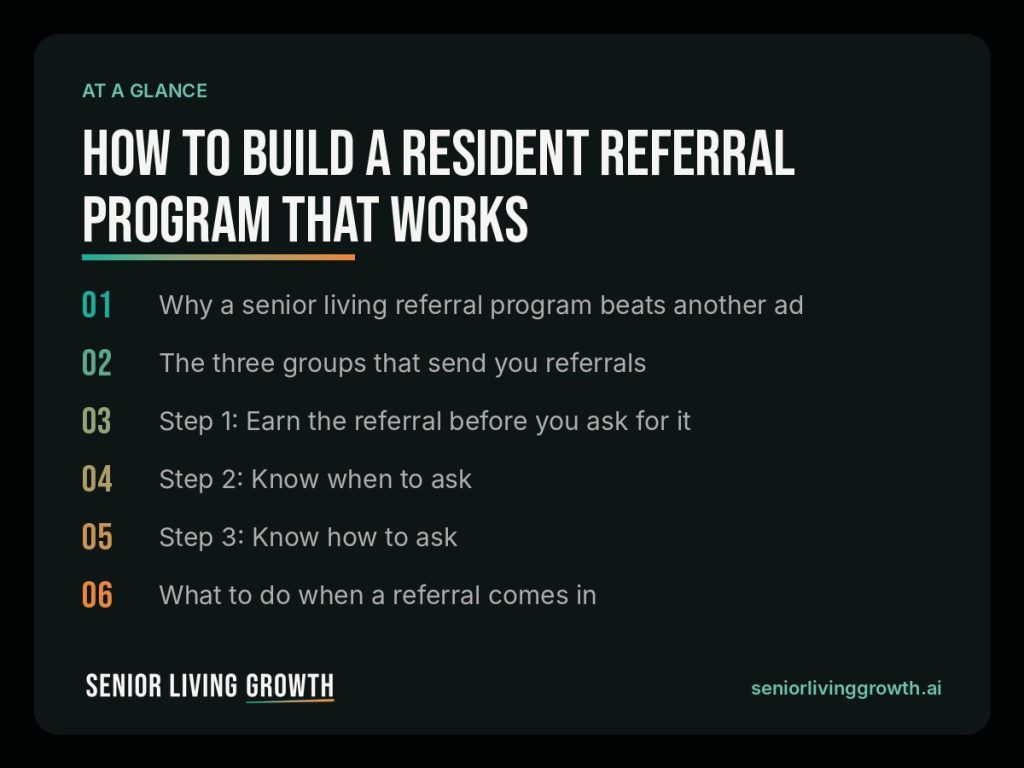
Why a senior living referral program beats another ad
Choosing senior living is one of the most emotional decisions a family makes. An ad can tell them you exist. A friend who says “my dad loves it there” tells them you can be trusted.
Referred families also tend to arrive warmer. They have already heard what life is like inside your building from someone who lives it. That makes for better tours and better conversations.
The catch: referrals don’t happen on their own at the rate they could. Most happy families never refer anyone because nobody ever asked, or they didn’t know how. A senior living referral program fixes that.
The three groups that send you referrals
When people talk about senior living referral sources, they usually mean three groups. Each one needs a slightly different approach.
- Residents and their families. Your strongest source of word of mouth. They know other families facing the same decision.
- Staff. Caregivers, nurses, dining and front desk teams live in your community too. Their neighbors, church friends and relatives ask them for advice.
- Professional referral partners. Discharge planners, home health and hospice teams, social workers, elder law attorneys, physicians’ offices and placement agents.
A resident referral program in senior living usually covers the first group, sometimes the second. Professional partners need their own approach, which we cover near the end.
Step 1: Earn the referral before you ask for it
No script fixes a poor experience. Before you launch anything, make sure the basics are strong: a smooth move-in, a check-in call in the first weeks, quick answers when families have concerns.
I tell every sales counselor the same thing: the referral is earned in the first 30 days and asked for after. If a family is still upset about a medication mix-up, asking them to refer a friend will feel tone-deaf.
Step 2: Know when to ask
Timing is most of the work. The best moments are when a family is already feeling good about you.
- After a positive 30-day or 60-day check-in.
- When a family thanks you, out loud or in writing.
- Right after a family leaves a kind review.
- After a great event, like a holiday party or a family dinner.
- On a move-in anniversary.
- When a family mentions a friend whose parent is struggling at home.
Avoid asking during a complaint, a health scare or a hard week. Read the room. A referral request should feel like an invitation, never pressure.
Step 3: Know how to ask
Keep it short, personal and easy to say yes to. Something like this:
“I’m so glad your mom is settling in. A lot of our families tell me they have friends going through the same thing. If you ever know someone who could use a hand, I’d be glad to talk with them, no pressure at all. Just give them my number.”
Then make it easy to act on:
- Hand them two of your cards, not one.
- Offer to text them a short note they can forward to a friend.
- Invite them to bring a friend to your next event or lunch.
For a ready-to-use script, see How to Ask for a Referral on our free templates page.
What to do when a referral comes in
A referral is a warm lead with a bit of trust already attached. How fast and how kindly you follow up decides whether that trust grows or fades. Treat it as the most important call of your day.
- Call the same day. If you can’t reach them, leave a short voicemail and send a text so they have your name and number.
- Say who sent you, if you have permission. Hearing a friend’s name opens doors that a cold call never will. If the person who referred them asked to stay out of it, respect that.
- Listen first. A referred family may be further along than most, or just starting. Learn their story before you talk about your community.
- Offer an easy next step. Lunch, a short visit or a phone call with another family member who is helping decide.
- Log it right away, with the name of the person who referred them, so you can thank them and track it.
Here is a sample opening for that first call. Change the words so it sounds like you:
“Hi, this is [your name] from [community]. [Friend’s first name] mentioned you might be looking into some extra help for your dad, and asked me to reach out. I’m not calling to sell you anything today. I’d just love to hear what’s going on and see if I can help, even if that means pointing you somewhere else.”
That last line matters. When a referred family isn’t a fit and you help them anyway, both families remember it. A senior living referral program runs on goodwill, and this is where you earn more of it.
Step 4: Bring your staff into it
Your team talks to more people in a week than your sales office does. A staff referral program gives them a clear, simple role.
- Teach one handoff. “I’d love to connect you with our sales director. Can I give them your number?” That’s it. Staff should not quote prices or make care promises.
- Make the path clear. Every staff referral goes to one person, who calls back the same day.
- Close the loop. Tell the staff member that the family was contacted, so they know it mattered.
- Recognize them. A shout-out at stand-up, a note from the executive director. Recognition goes a long way.
Step 5: Rewards, and the rules to check first
Many communities offer a thank-you for referrals that lead to a move-in. Common examples you’ll see published by operators include a rent credit for the referring resident once the new resident has lived there for a set time, such as 30 or 90 days. Others keep it to a handwritten note, flowers or a small gift.
Before you offer anything of value, slow down. Senior living sits close to health care, and referral rewards in health care can be regulated.
- The federal anti-kickback statute. According to the U.S. Office of Inspector General, it makes it a crime to knowingly and willfully pay anything of value to induce or reward referrals of items or services payable by federal health care programs such as Medicare and Medicaid. “Anything of value” can include more than cash. You can read the OIG’s plain-language summary on its fraud and abuse laws page.
- Your setting matters. The OIG has reviewed a few senior living referral arrangements in advisory opinions, for example rewards tied to private-pay independent living or programs that excluded residents on government funding. Those opinions apply only to the specific community that asked and the specific facts described, so they are not a green light for anyone else.
- Medicaid and other programs. If your community accepts Medicaid waiver residents or is connected to a skilled nursing, home health or hospice provider, the risk can look very different. Some operators exclude communities that accept Medicare or Medicaid from their reward programs entirely.
- State rules. Some states have their own anti-kickback or patient-brokering laws, and some of those can apply even when no government program pays. These vary a lot from state to state.
- Professional partners. Be especially careful with anyone who refers as part of their job, like discharge planners, social workers, physicians or home health staff. Placement agency fees are their own topic with their own contracts and, in some states, their own rules.
This is not legal advice. The safest move is simple: before you offer cash, rent credits or gifts to anyone for a referral, run your program by your compliance team or a health care attorney who knows your state.
Step 6: Say thank you every time
Thank the person for the referral itself, not just the move-in. Most referrals won’t become residents, and you still want that family to refer again.
- Within 24 hours: a call or text saying thank you and that you’ve reached out.
- Within a week: a handwritten note.
- Recognition: with permission, mention referring families in a newsletter or at a resident event.
- Protect privacy: don’t share details about the referred family’s health or decision without their OK. “We had a lovely conversation, thank you for thinking of us” is enough.
For professional partners, the Referral Partner Thank-You on our Free Templates page gives you wording you can send today.
Step 7: Track every referral
If you don’t track referrals, you can’t thank people properly, pay out any reward fairly or know if your senior living referral program works. Track these for every one:
- Who referred them (name and type: resident, family, staff, partner).
- Date received and date of first contact.
- Status: contacted, toured, deposit, moved in, not a fit.
- Thank-you sent, and when.
- Reward eligibility, if you offer one, and the date it was approved.
Review the list once a month. You’ll quickly see which families, staff and partners send you the most, and who deserves extra thanks. Referrals should be a line in your senior living marketing plan with a goal and an owner, just like your website or ads.
Sample senior living referral program outline
Writing your program down keeps it consistent when staff change or the sales office gets busy. Here is a sample one-page outline you can copy and change to fit your community. Have your compliance advisor review the rewards part before you share it with anyone.
1. Purpose
To thank the residents, families and team members who help other families find us, and to make sure every referred family gets a fast, caring response.
2. Who can refer
- Current residents and their family members.
- Team members in every department.
- Friends of the community, like volunteers and families of past residents.
3. How to refer
- Give the family the sales director’s card, or share their name and number with the sales office (with their permission).
- Staff: use the one-line handoff and send the name to the sales director the same day.
4. What happens next
- The sales office contacts the referred family within one business day.
- The person who referred them gets a thank-you within 24 hours and a handwritten note within a week.
- The referral is logged with its source and status.
5. Thank-yous and rewards
- Every referral gets a personal thank-you, whether or not the family moves in.
- Rewards, if any: ________ (only after review by our compliance advisor or health care attorney).
6. Privacy
We never share a referred family’s health details or decision with the person who referred them without the family’s permission.
7. Owner and review
Owner: ________. We review referral numbers every month and the senior living referral program as a whole once a year.
A short word on professional referral partners
Professional partners don’t want gifts. They want a community that makes their job easier. That means:
- Answering the phone, or calling back fast.
- Telling the truth about availability, care levels and pricing ranges.
- Doing assessments quickly when a hospital discharge is coming.
- Updating them, with the family’s permission, on how things went.
- Taking great care of the people they send.
Visit regularly, bring something useful (a one-page sheet on your care levels and current openings), and ask what is getting in their way. A partner who trusts you will think of you first.
Assisted living referral program ideas that don’t feel pushy
- Bring-a-friend lunch: residents invite a friend for a meal, no tour required.
- Family night: an event where current families can bring someone who is starting the search.
- Caregiver support group: host one monthly and let families invite friends.
- Move-in anniversary cards with a short note and two business cards inside.
- Resident ambassadors: a few happy residents who agree to say hello on tours.
- Staff spotlight: recognize team members whose referrals turned into great conversations.
- Partner lunch and learn: teach a topic partners care about, like what assisted living can and can’t handle.
Common mistakes that stall a senior living referral program
- Asking only once. A single ask on move-in day, when families are exhausted, is easy to forget. Ask at good moments all year.
- Slow follow-up on referrals. If a friend recommends you and the family waits three days for a call, you have let down two families, not one.
- Only thanking move-ins. Most referrals won’t move in. If you only thank the ones that do, people stop sending them.
- Leading with the reward. Families refer because they trust you, not for a rent credit. A reward can be a nice thank-you, but it should never be the pitch.
- Launching rewards before the compliance check. Undoing a reward program is harder and more awkward than waiting a few weeks to start it right.
- No owner. If nobody’s name is on the program, it fades the first busy month.
Fix these, and even a small senior living referral program can start to show up in your move-in numbers.
Start small this week
A senior living referral program doesn’t need a fancy launch. Pick three happy families, ask them this week using the script above, and start a simple log. Add staff next month. Talk to your compliance advisor before adding any rewards.
Want help with the words? Grab How to Ask for a Referral and the Referral Partner Thank-You from our free templates. They are free, and you can copy them in a minute.
Keep reading
- Senior Living Sales Training: 7 Skills Every Counselor Needs
- How to Run a Senior Living Tour That Ends in a Move-In
- The Assisted Living Move-In Checklist Families Will Thank You For
- More sales guides on the blog
FAQ
What is a resident referral program in senior living?
It is a simple, repeatable way for current residents and their families to recommend your community to friends. It usually includes when and how to ask, how you thank people and how you track each referral.
What are the best senior living referral sources?
Current residents and families, your own staff and professional partners like discharge planners, home health teams and elder law attorneys. Most communities get the best results by working all three with a different approach for each.
Can we give residents a reward for referring a friend?
Many communities do, often as a rent credit after the new resident has stayed for a set time. Referral rewards can be regulated in health care, including federal rules where Medicare or Medicaid is involved and some state laws, so check with your compliance team or a health care attorney first.
How long does it take a senior living referral program to work?
It depends on your community, but referrals rarely come in a rush. Most programs build slowly as more families are asked at the right moments and thanked well. Give a senior living referral program at least a few months of steady asking and tracking before you judge it.
When is the best time to ask for a referral?
Ask when a family is already happy with you, like after a good 30-day check-in, a kind review or a great event. Avoid asking during a complaint or a hard week.