Most families call two or three communities in the same afternoon. The counselor who answers first, listens best and follows up like they said they would usually gets the tour, and often the move-in.
That is what senior living sales training should build: a few skills, practiced every week until they are habits. This guide covers the seven skills I think every counselor needs, plus short role-play drills a sales director can run in a 30-minute team meeting. No theory, no slide decks. Just reps.
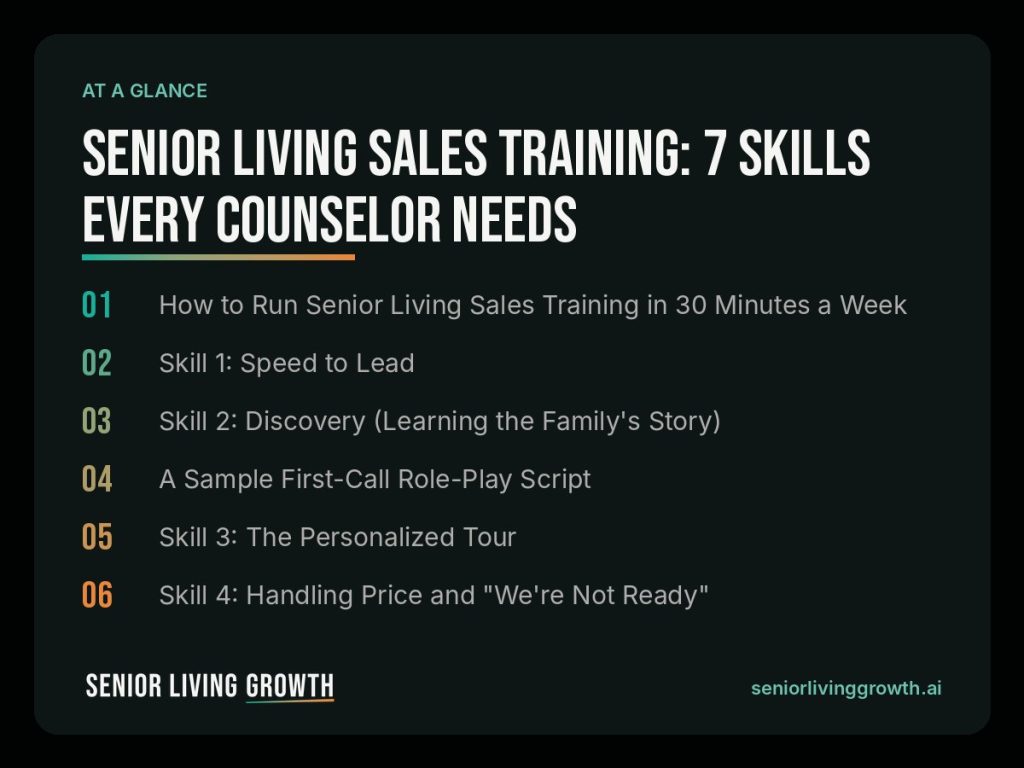
How to Run Senior Living Sales Training in 30 Minutes a Week
Long, once-a-year senior living sales training feels good and fades fast. Short, weekly practice sticks. Here is a simple format that fits into any team meeting:
- 5 minutes: numbers. Look at last week’s inquiries, reply times, tours and move-ins. No blame, just facts.
- 20 minutes: one drill. Pick one skill below. Pair people up. One plays the family, one plays the counselor, one watches and gives feedback. Then switch.
- 5 minutes: one commitment. Each person says one thing they will do differently this week.
Work through one skill per week. After seven weeks, start over. The second time through is where the real progress shows up.
Skill 1: Speed to Lead
When a family reaches out, they are usually worried and ready to talk right now. If they get voicemail and no reply, they call the next community on their list.
Speed to lead means treating every call, form and text as urgent. Answer live when you can. When you can’t, reply within minutes, not hours. A short text back after a missed call buys you time and shows the family someone cares.
If your team does not have one yet, grab the free Missed-Call Text Back template and set it up on every line families call.
Drill: The two-minute callback
The leader reads a fake web inquiry out loud. The counselor has two minutes to call back. The “family” is distracted, in a parking lot, and short on time. The goal is simple: introduce yourself warmly, ask one good question and book a next step before the call ends.
Skill 2: Discovery (Learning the Family’s Story)
Nobody calls a senior living community because they want an apartment. They call because something happened. Mom fell. Dad got lost driving home. A daughter is exhausted from caregiving and feeling guilty about it.
Discovery is learning that story and the real reason they called today. Ask open questions, then be quiet and listen:
- “What’s going on that made you reach out now?”
- “Tell me about your mom. What does a good day look like for her?”
- “What worries you most right now?”
- “Who else is part of this decision?”
I tell every new counselor the same thing: if you are talking more than the family on the first call, slow down. Your job on that call is to understand, not to pitch.
Drill: Find the “why”
The leader writes a short family story on a card and hands it to the person playing the family. The counselor has five minutes of questions to uncover it. Afterward, the counselor repeats the story back. The watcher scores how close they got and how many questions were open-ended.
A Sample First-Call Role-Play Script
New counselors learn faster in senior living sales training when they can hear what a good call sounds like. Use this sample in your discovery drill. Read it aloud once, then have pairs run it in their own words. It is an example to learn from, not a script to memorize.
Counselor: “Thanks so much for calling. This is Jordan. Who am I speaking with?”
Family: “Hi, I’m Karen. I’m calling about my mom. I just wanted to get some prices.”
Counselor: “I’m glad you called, Karen, and I’ll make sure you get pricing. So I can give you numbers that actually fit, can I ask a little about your mom? What’s going on that made you reach out now?”
Family: “She fell last week. She’s okay, but I live 40 minutes away and I’m worried about her being alone.”
Counselor: “That sounds scary, for both of you. I’m glad she’s okay. How is she doing since the fall, and how are you holding up?”
Family: “Honestly, I’m exhausted. I’ve been driving over every day.”
Counselor: “That is a lot to carry. Tell me about your mom. What does a good day look like for her?”
Notice what happened. The counselor didn’t dodge the price question. They promised an answer, then asked permission to learn more first. They named the feeling, asked about the caregiver too and moved toward the person, not the apartment.
In the drill, have the watcher listen for three things. Did the counselor ask why now? Did they ask about the person, not just the care needs? Did the call end with a clear next step, like a tour time or a follow-up call?
Skill 3: The Personalized Tour
A tour that walks past every room in the same order for every family is a building tour. A great tour is built around what you learned in discovery.
If Dad loved woodworking, stop at the workshop and introduce him to the resident who runs it. If Mom is a picky eater, plan the visit around lunch. If the daughter is worried about night care, show her how the overnight team checks in, and let her ask staff directly.
We go deeper on this in our guide to a senior living tour that families remember.
Drill: Plan the tour in three stops
Give the team the same family story from last week. Each person writes down the three stops they would make and why, plus one question they would ask at each stop. Share and compare. You will be surprised how different the tours are.
Skill 4: Handling Price and “We’re Not Ready”
These are the two objections every counselor hears most. Neither one is usually a hard no.
When price comes up
Don’t dodge it, and don’t lead with a discount. Acknowledge the concern, then help the family compare fairly. Living at home has costs too: in-home help, meals, home repairs, transportation, and the hours a family caregiver gives up. Walk through what is included so they are comparing like to like. If you have more than one price point or care level, explain the options plainly.
When they say “we’re not ready”
Respect it. Then get curious: “That makes sense. What would need to happen for you to feel ready?” Often the answer is a fear you can address, like losing independence, or a family member who isn’t on board yet. Sometimes it really is timing, and your job is to stay helpful until it isn’t.
Drill: Objection rounds
Write ten common objections on slips of paper. Each counselor draws one and responds in under a minute. The rule: acknowledge first, ask a question second, give information third. The watcher checks that all three happened.
Skill 5: A Follow-Up Cadence You Actually Keep
Most moves happen weeks or months after the first call. The counselor who stays in touch, kindly and usefully, is still in the picture when the family is ready.
A good follow-up cadence has a plan: a thank-you the same day as the tour, something helpful a few days later, and a gentle check-in about a week out. After that, keep a steady rhythm. Each touch should give the family something, like an answer to a question they asked, an invite to lunch or an event, or a resource that helps them plan.
The free Three Post-Tour Messages template gives your team ready-to-send texts for day one, day three and day seven. One tip from that template is worth repeating: keep messages warm and short, and leave health details out unless the family brings them up first.
Drill: Write it on the spot
Pick a real recent tour (no names out loud). Each person writes the day three message in five minutes. Read them aloud. Vote on the one that sounds most like a real person and least like a sales pitch.
Skill 6: Working With Referral Partners
Hospital case managers, rehab social workers, home health teams, placement agents and elder law attorneys all meet families before you do. When they trust you, they send families your way.
Trust comes from being easy to work with. Answer their calls fast. Tell them honestly when you’re not a fit. Close the loop when a referral moves in. And thank them every time.
The free templates page has a Referral Partner Thank-You and a guide on how to ask for a referral. For a full plan, see our post on building a senior living referral program.
Drill: The 60-second partner visit
One person plays a busy hospital discharge planner with one minute to spare. The counselor must introduce the community, say who it is a good fit for (and who it is not), and leave one useful thing behind. Time it strictly. Busy partners will.
Skill 7: Tracking Your Numbers
You can’t fix what you don’t measure. Every counselor should know their own numbers each week, not just the director.
Start simple. Track new inquiries, average time to first reply, tours booked and move-ins. Then watch two conversion rates: inquiries to tours, and tours to move-ins. If inquiries are healthy but tours are low, work on discovery and the first call. If tours are healthy but move-ins are low, work on the tour and follow-up.
The free Weekly Lead Tracker has these columns ready to go. Fill in one row every Friday and look at the trend, not one week.
Drill: Read the numbers
Show the team a made-up month of numbers with one obvious leak, like slow reply times or lots of tours with few move-ins. Ask: “Where is the problem, and which skill would fix it?” This teaches counselors to coach themselves.
A Simple Scorecard for Call and Tour Reviews
Feedback is easier when everyone knows what “good” looks like. Use this short scorecard for role-plays and, with proper notice and permission, for real call reviews. Score each line 1 (not yet), 2 (getting there) or 3 (nailed it).
- Warm greeting, and used the caller’s name.
- Asked why the family is reaching out now.
- Asked about the person: their life, likes and daily routine.
- Asked who else is part of the decision.
- Listened more than talked.
- Answered the family’s questions honestly, including price when asked.
- Connected what the community offers to what the family shared.
- Booked a clear next step with a date and time.
- Logged notes and the follow-up date right after.
Don’t use the score to grade people. Use it to pick the one line each counselor works on next week. Over time, the scores become a simple way to see whether your senior living sales training is changing real calls.
How to Give Feedback That Helps
Role-play only works if the feedback is useful and safe to hear. Keep it short and follow the same pattern every time:
- One thing that worked. Be specific. “When you asked about her garden, her whole voice changed.”
- One thing to try. Just one. “Next time, ask who else is part of the decision before you talk about price.”
- Try it again right away. Run the same moment a second time so the new habit has a chance to stick.
Let the counselor give themselves feedback first, then the watcher, then the leader. People accept feedback more easily when they found part of it themselves. This simple pattern is the quiet engine of good senior living sales training.
Senior Living Sales Tips for Sales Directors
A few things make senior living sales training work better:
- Practice on real situations. Use last week’s tough calls (with names removed) as drill material.
- Keep it safe. Role-play feels awkward. Go first yourself, and praise effort before giving feedback.
- Listen to real calls when you can. With proper notice and permission where your state requires it, reviewing calls shows you what training is actually sticking.
- Train the whole building. Receptionists, nurses and dining staff all talk to families. Even a short version of these drills helps.
- Make the basics easy. Have your team practice answering the questions families ask most, like how pricing works and what the move-in process looks like. The Questions to Answer First list is a great script for this.
Training Mistakes Sales Directors Make
- Training once and calling it done. A full-day workshop is a fine start. Without weekly practice, most of it fades within weeks.
- Only teaching the product. Knowing your floor plans matters, but families decide based on trust. Spend more time on listening and follow-up than on features.
- Skipping drills when the team is busy. Busy weeks are exactly when habits slip. Shorten the drill to ten minutes instead of skipping it.
- Practicing only the easy calls. The calls that go wrong are the best drill material. Use them, with names removed.
- Never checking the numbers. If reply times, tours and move-ins don’t move after a few months, change what you practice.
Senior living sales training should feel more like practice for a team sport than a class: short, regular, a little uncomfortable and always tied to real calls. When your senior living sales training looks like that, the skills start showing up with real families.
Assisted Living Sales Training for New Hires
New counselors often come from hotels, healthcare, real estate or other sales jobs. They bring great skills, but assisted living sales is different. Families are often in crisis, decisions involve several people, and the “product” is someone’s home and care.
For a new hire’s first month, I would focus on three things in this order: speed to lead, discovery and follow-up. Those three alone will make them better than many counselors in their market. Tours, objections and referral partners come next. If you are hiring, our guide to senior living sales jobs covers what great reps do in their first 90 days.
If you want to see how these skills fit into the full path from first call to move-in, this breakdown of the senior living sales process walks through each stage.
Start This Week
Good senior living sales training doesn’t need a big budget or an outside trainer. You need 30 minutes a week, one skill at a time and the discipline to keep going. Pick skill one, run the drill at your next team meeting and see what changes.
To make it easier, every template mentioned here is free on our free templates page. Copy them, change the words to fit your community and put them to work today.
Keep reading
- How to Build a Senior Living Marketing Plan (Free Template)
- The Assisted Living Move-In Checklist Families Will Thank You For
- More sales guides on the blog
FAQ
What should senior living sales training include?
Good training covers the skills that move families from first call to move-in: speed to lead, discovery, personalized tours, handling objections, follow-up, referral partners and tracking numbers. The best programs practice these skills weekly with role-play, not just once a year in a classroom.
How do we know if our senior living sales training is working?
Watch your numbers over a few months: time to first reply, inquiries to tours and tours to move-ins. If those improve and call reviews score higher, the training is sticking. If nothing moves, change which skill you practice.
How often should a sales team do role-play?
Weekly works well. A short 20-minute drill inside a regular team meeting builds habits faster than a long annual training. Rotate through one skill per week and repeat the cycle.
What is the most important skill for a senior living sales counselor?
If you only work on one, start with speed to lead. A family who can’t reach you will often call the next community, and you never get the chance to use your other skills. Discovery is a close second.
Is assisted living sales training different from other sales training?
The basics are similar, but the setting is different. Families are often stressed or grieving, several people share the decision, and timelines can be long. Training should focus on listening, patience and steady follow-up rather than pressure.