
Most senior living communities are not short on marketing activity. They are short on a plan that connects all that activity to the one number that matters: move-ins.
A senior living marketing plan fixes that. It is a short document your sales and marketing team can read in five minutes, that says who you are trying to reach, how, with what money, and how you will know it worked. Below you will find how to build one, plus a free fill-in-the-blanks template you can copy today.
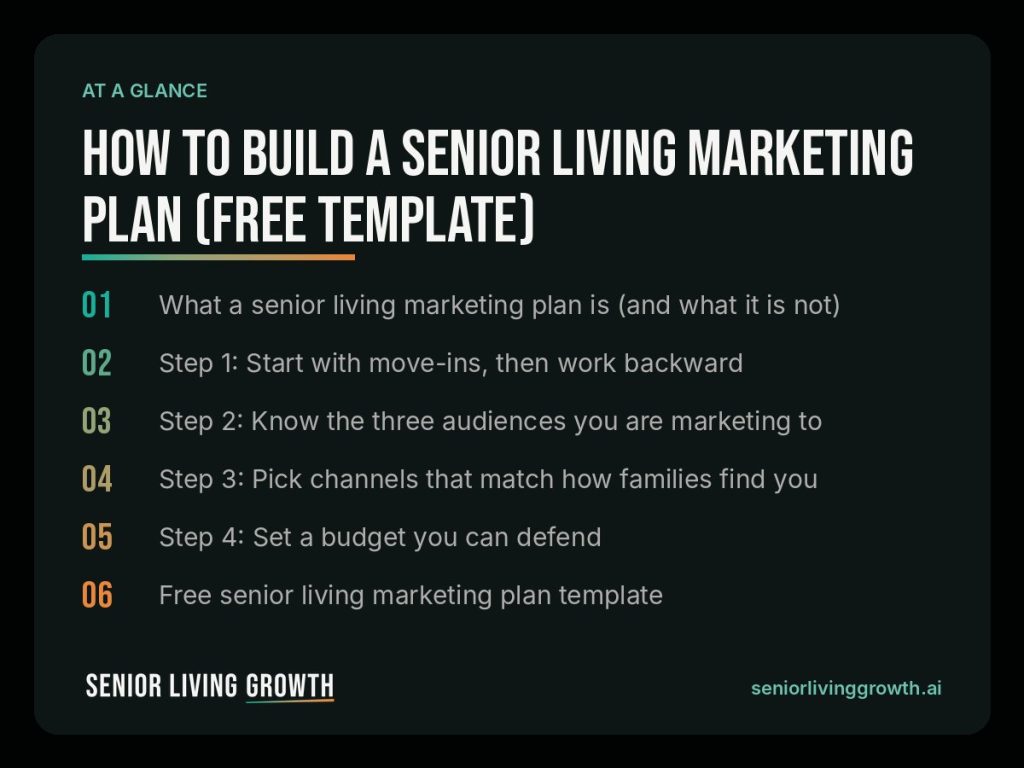
What a senior living marketing plan is (and what it is not)
A good plan is one page. It starts with a move-in goal, works backward to the leads and tours you need, and lists the few channels that will get you there.
It is not a brand book, a 40-page slide deck, or a list of every idea anyone ever had. If your team can’t remember what is in it, it won’t change what they do on Monday morning.
It also isn’t the same as a marketing strategy guide. A guide explains tactics. A plan picks the tactics that fit your building, your budget and your occupancy, and puts names and dates next to them. If you want deeper tactics for each channel, the Pathly CRM senior living marketing guide covers them in detail. This article is about the plan itself.
Step 1: Start with move-ins, then work backward
I tell every team the same thing: don’t start with “more leads.” Start with how many families need to move in, then do the math.
- Count your open units and your target occupancy for the next 6 to 12 months.
- Estimate move-outs. Look at your last 12 months. Residents pass away, move to a higher level of care or move closer to family. You have to replace those too.
- Add them up. Open units you want to fill plus expected move-outs equals the move-ins you need.
- Use your own conversion rates. Pull the last 6 to 12 months from your CRM or lead log: how many leads became tours, and how many tours became move-ins.
- Work backward. Divide move-ins needed by your tour-to-move-in rate to get tours needed. Divide tours needed by your lead-to-tour rate to get leads needed.
Here is an example with made-up numbers, just to show the math. Say you need 4 move-ins a month. If 1 in 4 tours moves in, you need 16 tours. If 1 in 3 leads tours, you need about 48 leads a month. Your numbers will be different, and that is the point. Use yours, not an industry average.
Once you have that, every channel in your plan has a job: help produce those leads and tours.
Step 2: Know the three audiences you are marketing to
An assisted living marketing plan that talks to “seniors” only will miss most of the decision. In practice you are marketing to three groups at once.
Adult children
Often the first to search, the first to call and the person juggling the decision with a job and kids. They want fast answers, clear pricing ranges, an easy way to book a tour and proof that other families trust you.
Seniors
The person who will actually live there. They care about dignity, independence, food, friends and staying connected to the life they have. Your photos, events and tours need to speak to them, not just about them.
Referral partners
Hospital discharge planners, home health and hospice teams, elder law attorneys, physicians’ offices, placement agents and other professionals. They want a community that answers the phone, tells the truth about availability and takes good care of the people they send. A strong senior living referral program also turns current residents and families into a fourth source of word of mouth.
Step 3: Pick channels that match how families find you
You don’t need every channel. You need the ones that actually produce tours for your community, done well and done every week. Here is what each one is for in a marketing plan for a senior living community.
- Website: Your 24/7 tour desk. Clear care levels, real photos, a phone number that is easy to tap and a simple way to request a tour.
- Google Business Profile: Often the first thing a family sees when they search your name or “assisted living near me.” Keep hours, photos, categories and phone number current.
- Reviews: Families read them before they call. Ask every family, not just the happy ones, and reply to every review, good or bad. Google’s own review rules say not to selectively ask only happy customers or to reward people for reviews.
- Referral partners: Regular, useful visits and fast responses. One great discharge planner relationship can be worth more than a month of ads.
- Events: Lunch and learns, caregiver support groups, open houses. Good events give people a reason to walk in before they need you.
- Social media: Proof of life. Show real moments, staff and events so families can picture their parent there.
- Email: Gentle, helpful follow-up for families who are “not ready yet,” which is most of them.
- Paid ads: Useful for filling gaps fast, but only if your phones are answered and leads are followed up the same day. Otherwise you are paying for leads you will lose.
For most communities, the basics come first: website, Google profile, reviews, referral partners and fast follow-up. Add the rest once those are solid.
Step 4: Set a budget you can defend
There is no single right budget for a marketing plan for an assisted living facility. It depends on your size, your market, how full you are and how much of your marketing your own team does.
A simpler way to think about it: what does a move-in mean to your community over a typical length of stay, and what is a fair cost to get one? Once you track cost per move-in by channel, budget conversations get much easier.
- Fund what is already producing move-ins first.
- Set aside a small amount to test one new thing per quarter.
- Cut what has had a fair test and hasn’t produced tours.
- Don’t forget time. A referral partner visit costs nothing on paper, but it costs your best people hours.
Free senior living marketing plan template
Copy this into a document, fill in the blanks with your team and print it. If a section takes more than a few lines, you are probably overthinking it.
1. Goals (next 90 days)
- Current occupancy: ____ % (____ of ____ units)
- Target occupancy by ________: ____ %
- Expected move-outs in this period: ____
- Move-ins needed: ____ (about ____ per month)
- Tours needed per month: ____ (based on our tour-to-move-in rate of ____ %)
- Leads needed per month: ____ (based on our lead-to-tour rate of ____ %)
2. Audiences
- Adult children: what they worry about most is ________. Our message to them: ________.
- Seniors: what matters most to them is ________. Our message to them: ________.
- Referral partners: our top 10 targets are ________. What they need from us: ________.
3. What makes us the right choice
- Three things families say they love about us: ________, ________, ________.
- The one thing we want every family to remember after a tour: ________.
4. Channels, owners and weekly actions
- Website: owner ________. Weekly action: ________.
- Google Business Profile: owner ________. Weekly action: ________.
- Reviews: owner ________. Goal: ____ new reviews a month.
- Referral partners: owner ________. Goal: ____ visits a week.
- Events: owner ________. Next event: ________ on ________.
- Social media: owner ________. Posts per week: ____.
- Email: owner ________. Sends per month: ____.
- Paid ads: owner ________. Monthly spend: $____.
5. Budget
- Total monthly marketing budget: $____
- Biggest line items: ________ $____, ________ $____, ________ $____
- Test budget for one new idea this quarter: $____ for ________
6. Calendar
- Weekly lead meeting: ________ (day and time)
- Monthly numbers review: ________ (date)
- Events this quarter: ________
- Seasonal pushes (holidays, spring open house): ________
7. Tracking
- Where we log every lead: ________
- Numbers we review weekly: leads by source, response time, tours, deposits, move-ins.
- Numbers we review monthly: cost per move-in by channel, reviews, referral partner visits.
Example: a filled-in plan for a 60-unit community
Seeing a finished page makes it easier to fill in your own. Here is a short example. The community and every number in it are made up to show how the pieces fit together, so don’t copy the numbers. Copy the shape.
- Goal: go from 48 to 54 residents (80% to 90% occupancy) over the next three months. We expect about 3 move-outs in that time, so we need 9 move-ins, or 3 a month.
- Tours and leads: 1 in 4 of our tours moves in, so we need 12 tours a month. 1 in 3 of our leads tours, so we need about 36 leads a month.
- Audience focus: adult children within a 20-minute drive, plus the two hospitals and three home health agencies closest to us.
- Why us: families mention our dining, our long-time caregivers and our garden.
- Channels and owners: the sales director owns referral partners (6 visits a week) and the Monday lead meeting. The sales counselor owns follow-up and review requests (goal: 4 new reviews a month). The executive director owns the Google profile and one event a month. Paid ads stay paused until our reply time is under one hour.
- Tracking: every lead goes into one log with its source. We review numbers every Monday and cost per move-in on the first Friday of each month.
Notice what is missing: no long list of ideas, no channel without an owner and no goal without math. That is what makes a senior living marketing plan something a team can follow during a busy week.
Step 5: Build a simple weekly and monthly calendar
A senior living marketing plan only works if it turns into a rhythm. Here is a calendar that fits most sales and marketing teams.
Every week
- Monday: 30-minute lead meeting. Review every open lead, who is following up and when.
- Every day: Call back new leads the same day. Text back missed calls within minutes if you can.
- Midweek: Referral partner visits, booked in advance.
- Friday: Send review requests to families who had a good week, check your Google profile and post on social.
Every month
- Review your numbers against the goal in your plan.
- Hold at least one event or open house.
- Send one helpful email to your “not ready yet” list.
- Decide one thing to stop, one to keep and one to try.
Tours are where your plan pays off, so make sure the team is ready for them. Our guide to the senior living tour walks through how to make every visit count.
Step 6: Track the numbers that tell the truth
If you only track one thing, track where each move-in came from. That single habit will tell you more than any report.
Beyond that, keep it small:
- Leads by source: website, phone, Google, referral partner, resident referral, event, ad.
- Speed to first response: how fast a real person reaches a new family.
- Tours, deposits and move-ins each week.
- Conversion rates: lead to tour, tour to move-in.
- Cost per move-in by channel, once a month.
The free Weekly Lead Tracker and Review Request Text on our free templates page make two of these habits easy to start this week.
The step most plans skip: what happens after a lead comes in
Most plans spend pages on getting leads and one line on what happens next. That is backward. A senior living marketing plan that brings in 50 leads a month and answers them slowly can easily lose to a plan that brings in 30 and answers every one fast.
Write a simple lead response standard into your plan. It should answer these questions in plain words:
- Who answers new calls during business hours, and who covers lunch, tours and days off?
- What happens after hours and on weekends. Does the call go to voicemail, a team member’s cell phone or an answering service? Does the family get a text back?
- How fast a real person follows up on a web form, a missed call or a referral. Pick a clear target, like within one hour during business hours, and hold the team to it.
- What the first call should do: learn the family’s story, answer their top question and offer a tour or another next step.
- How many times you follow up with a family that doesn’t answer, and over how many days, before they move to a monthly “not ready yet” list.
- Where every lead gets logged, so no family lives only in someone’s inbox or on a sticky note.
This part of the plan costs almost nothing, and it protects every dollar you spend on the rest. The free Missed-Call Text Back and Three Follow-Up Messages templates give your team the words, so the standard is easy to keep.
Common mistakes that sink a senior living marketing plan
- Goals with no math. “Increase occupancy” is a wish. “12 move-ins by March 31” is a goal.
- Too many channels. Doing eight things poorly loses to doing four things every week.
- Marketing and sales working apart. If marketing brings leads and nobody calls them back fast, the plan fails.
- No owner. Every line in the plan needs a name next to it.
- Never looking back. A plan that is never reviewed becomes a document in a drawer.
Rolling out your plan in the first 90 days
Don’t try to launch everything on day one. A new senior living marketing plan works best when you fix the basics first and add more once they are steady.
- Days 1 to 30: fix the leaks. Set up your lead log, your lead response standard and your Monday meeting. Clean up your Google Business Profile and make sure your website’s phone number and tour button work on a phone.
- Days 31 to 60: build relationships. Start referral partner visits on a set schedule. Begin asking every family for a review. Send your first helpful email to the “not ready yet” list.
- Days 61 to 90: test and review. Hold an event. Try one new idea with your test budget. Then sit down with the numbers and decide what to keep, stop and change for the next quarter.
By day 90 you will have real numbers from your own community. That makes the next plan sharper and much easier to write.
Your next step
Block one hour with your sales and marketing team this week. Do the move-in math, fill in the template above and pick your weekly meeting time. You will have a working senior living marketing plan before the hour is up.
Then grab the free scripts and trackers on our Free Templates page so the plan has tools behind it from day one.
Keep reading
- Senior Living Sales Training: 7 Skills Every Counselor Needs
- The Assisted Living Move-In Checklist Families Will Thank You For
- How to Become a Certified Assisted Living Administrator
- More marketing guides on the blog
FAQ
What should a senior living marketing plan include?
It should include a move-in goal, the leads and tours needed to reach it, your audiences, your chosen channels with an owner for each, a budget, a calendar and the numbers you will track. Keep it to one page so your team actually uses it.
Is an assisted living marketing plan different from one for independent living?
The structure is the same, but the audience mix often changes. Assisted living and memory care decisions are frequently driven by adult children and referral partners, often after a health event, so speed and trust matter even more.
How often should we update our marketing plan?
Review the numbers every week and your senior living marketing plan every month. Rewrite the goals each quarter, or sooner if occupancy changes quickly.
Who should own the senior living marketing plan?
One person should own the plan as a whole, usually the sales director or executive director, even if some marketing help comes from outside. Each line in the plan still needs its own owner, because when everyone owns it, nobody does.
How much should a senior living community spend on marketing?
It varies by size, market and occupancy, so there is no single right number. Start by tracking cost per move-in by channel, then put more money behind what is producing move-ins.