Every assisted living community needs one person the state holds responsible for how the building runs. In most states, that person needs some form of assisted living administrator certification before they can take the job, or soon after.
The tricky part is that no two states do it the same way. Some issue a license, some issue a certificate, and some only ask for training hours. This guide explains the common patterns, shows how five states handle it, and walks you through the steps whether you plan to become the administrator yourself or hire one.
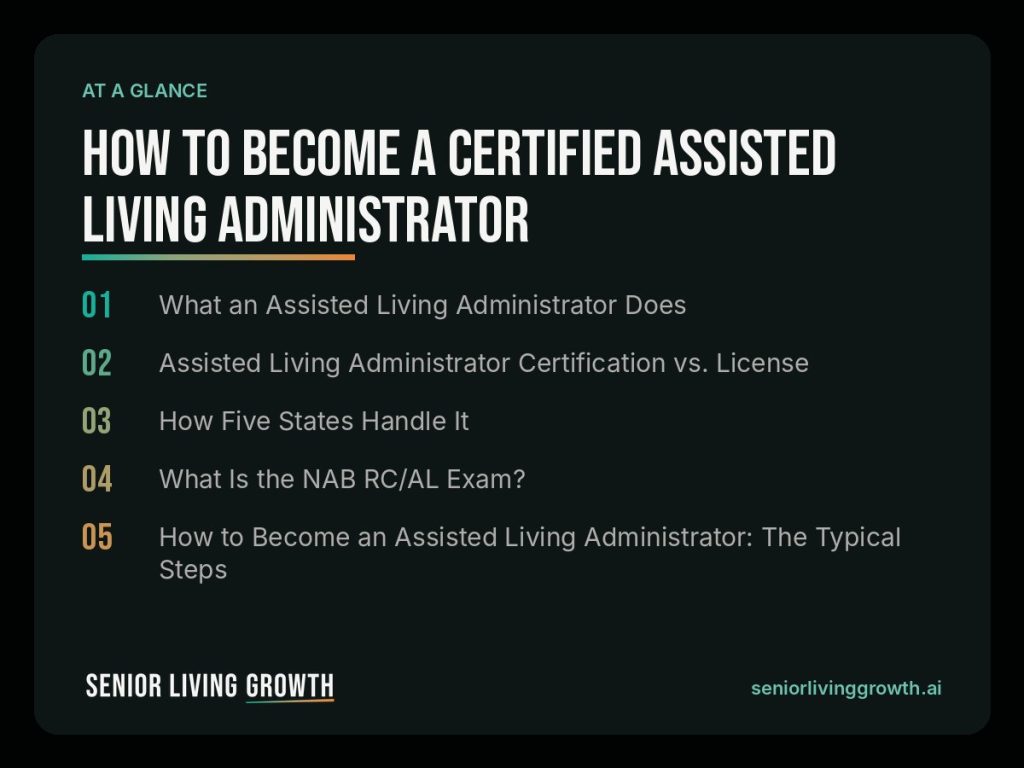
What an Assisted Living Administrator Does
The administrator is the person in charge of daily operations. They make sure the community follows state rules, keeps residents safe and keeps good records. They usually oversee staffing, resident care plans, budgets, emergency planning and state inspections.
In smaller homes, the administrator often handles a lot more: answering calls from families, giving tours and talking with referral partners. That is why the right person in this seat matters so much to both care and occupancy, and why owners should understand assisted living administrator certification even if they never hold it themselves.
Assisted Living Administrator Certification vs. License
People use “certification” and “license” like they mean the same thing. In practice, states fall into a few patterns:
- A state license from a board. You meet education and experience rules, finish a course, pass exams and get licensed. Minnesota works this way.
- A state certificate from a health or social services department. You take an approved course, pass a state exam and receive a certificate. California and New Jersey work this way.
- Required training plus a competency test. You complete state core training and pass a test within a set time after you start. Florida works this way.
- Required training hours only. You show proof of a set number of training hours. Colorado works this way.
Rules change, and these summaries are a starting point, not legal advice. Always confirm the current requirements with your state’s licensing agency before you sign up for a course or hire someone.
How Five States Handle It
California: Department of Social Services
In California, assisted living is called a Residential Care Facility for the Elderly (RCFE). The Administrator Certification Section of the California Department of Social Services certifies administrators. The basic path:
- Complete an approved 80-hour Initial Certification Training Program
- Take the state exam within 60 days of finishing the training
- Apply within 30 days of passing the exam
- Get a criminal record clearance through fingerprinting
Certificates renew every two years. Renewal for RCFE administrators takes 40 hours of continuing education, including at least 8 hours on dementia care. Licensed nursing home administrators have a shorter path to the initial certificate.
Florida: Agency for Health Care Administration
Under Florida law, an assisted living administrator must finish the state’s required core training, including a competency test, within 90 days of starting the job. After that, administrators need at least 12 hours of continuing education every two years. Florida’s Agency for Health Care Administration oversees assisted living facilities in the state.
Minnesota: Board of Executives for Long-Term Services and Supports
Minnesota requires every assisted living facility to have a Licensed Assisted Living Director. The license comes from the Board of Executives for Long-Term Services and Supports (BELTSS). Applicants need:
- A mix of education and work experience in long-term care (for example, a high school diploma plus two years of experience, with one year in a management or supervisory role)
- An approved course that includes a practicum
- Passing scores on the national NAB Core and RC/AL exams, plus a state exam
- A criminal background check
The license renews every year, and directors need 30 hours of continuing education every two years.
New Jersey: Department of Health
New Jersey certifies assisted living administrators through its Department of Health. Applicants complete an assisted living training course, pass the Assisted Living Competency Examination within two years of finishing the course and pass a criminal background check. The certificate lasts three years, and renewal requires at least 30 hours of continuing education.
Colorado: Department of Public Health and Environment
Colorado’s health department requires assisted living administrators to show proof of 40 hours of training. Twenty hours cover regulations, like residents’ rights, fire safety, emergency procedures and nutrition. The other twenty cover how to meet residents’ personal, social and emotional needs. A state medication course does not count toward the 40 hours.
What Is the NAB RC/AL Exam?
NAB stands for the National Association of Long Term Care Administrator Boards. It creates national exams that many state boards use. NAB says its Residential Care/Assisted Living (RC/AL) exam is a required part of licensure in several states.
Here is how the exams are set up, according to NAB:
- Core exam: 125 questions (100 scored) with 150 minutes of seat time
- RC/AL line of service exam: 75 questions (60 scored) with 90 minutes of seat time
You can’t just sign up on your own. Your state board has to approve you first, and the state decides which exams you need. Minnesota, for example, requires both the Core and RC/AL exams for its assisted living director license.
How to study for the NAB exams
If your state’s assisted living administrator certification includes NAB exams, start with NAB’s own exam information page. NAB doesn’t point to one single study book. It says all of the resources on its recommended reference list are used to build the exams, and it asks candidates to read its candidate handbook, which covers fees, scheduling and withdrawals, before applying.
A few habits help most test takers:
- Review NAB’s domains of practice so you know what the exams cover.
- Study in short, regular sessions instead of cramming the week before.
- Work through practice questions, then learn why each wrong answer was wrong.
- Ask your course provider whether it offers prep for the exact exam you need.
- Learn your own state’s rules too, since some states add a state exam on top of NAB’s.
How to Become an Assisted Living Administrator: The Typical Steps
Every state is different, but most paths follow this order:
- Find your state’s agency. Search your state name plus “assisted living licensing.” It is usually the health department, social services department or a licensing board.
- Read the administrator rules. Look for minimum age, education, experience and background check rules.
- Take an approved course. Choose a certified assisted living administrator course from your state’s approved list.
- Pass the required exams. This could be a state exam, NAB exams or both.
- Apply and clear your background check. Watch the deadlines. Some states give you only a short window after training or testing.
- Keep it current. Track your continuing education hours and renewal date from day one.
A 30-Day Plan to Start Your Assisted Living Administrator Certification
The steps above can feel like a lot at once. Here’s a simple way to break your first month into small jobs. Your state may move faster or slower, but this keeps you from stalling.
Week 1: Find the rules and the right office
- Find your state’s licensing agency and bookmark its administrator page.
- Download the actual rules, not just a summary, and highlight every line about administrators.
- List each requirement in one place: age, education, experience, training hours, exams, background check and fees.
Week 2: Call the agency with your questions
A ten-minute call can save you weeks. Have these questions ready:
- “Does an administrator here need a license, a certificate or only training hours?”
- “Where can I find the list of approved courses?”
- “Which exams do I need, and how do I get approved to take them?”
- “Are there deadlines after I finish training or pass an exam?”
- “Can I work as administrator while I finish my assisted living administrator certification, or do I need it first?”
- “How does the background check work, and how long does it usually take?”
Write down the name of the person you spoke with and the date. If an answer matters a lot, ask where it’s written in the rules.
Week 3: Choose and book your course
- Pick two or three courses from the approved list and compare dates, format and total cost.
- Confirm the course prepares you for the exam your state uses.
- Put the course dates, exam window and application deadline on your calendar right away.
Week 4: Start the paperwork
- Gather the proof of education and work history your state asks for.
- Start the background check as early as your state allows.
- Make one folder, paper or digital, for certificates, receipts and emails. You’ll need them again at renewal time.
Common Mistakes That Delay Assisted Living Administrator Certification
Most delays come from small, avoidable slips. Watch for these:
- Paying for a course before checking approval. If it isn’t on your state’s list, the hours may not count, and you end up paying twice.
- Missing a deadline. Some states give you a set window. In California, for example, you have 60 days after training to take the exam and 30 days after passing to apply.
- Starting the background check late. Fingerprinting and clearance take time, so begin as soon as your state lets you.
- Assuming your credential moves with you. Each state sets its own rules, so don’t assume a credential from one state works in another. Ask the new state’s agency what it accepts.
- Leaving continuing education to the last minute. Renewal hours often come with rules about topics and live training. Log each class the day you finish it.
- Letting it lapse. Put your renewal date on your calendar with reminders 90 days and 30 days ahead.
Keep Your Certification Current: A Simple Tracking Sheet
Renewal is part of assisted living administrator certification too, and it’s much easier when you track as you go. Set up a simple sheet with these columns:
- Course name and provider
- Date finished
- Number of hours
- Topic, especially any your state requires, like dementia care
- Format: live, live online or self-paced
- Whether the provider is approved by your state
- Where the certificate is saved
Check the total against your state’s renewal rule every few months. If you’re short, you’ll know with plenty of time to fix it.
Assisted Living Administrator Training Online: What to Check
Plenty of companies sell assisted living administrator training online, and many promise a fast path to assisted living administrator certification. Some are great. Some are not approved in your state, which means the hours may not count. Before you pay, check these things:
- Is it on your state’s approved list? Approval matters more than the course website.
- Does the format count? Some states require part of the training to be live, even if it is on video. California, for example, requires at least half of renewal hours to be live.
- Do the hours match your state’s rule? An 80-hour course in one state may not fit another state’s rules.
- Does it prepare you for the exam you need? Ask which exam the course covers.
- Is it a real credential? A “national certificate” from a training company is not the same as a state license or certificate.
For New Owners: Become the Administrator or Hire One?
If you are opening or buying a home, this is one of your first big decisions. Both paths can work.
Becoming the administrator yourself
Doing it yourself helps you learn the rules inside and out and saves a salary early on. But first check whether you meet your state’s education and experience rules for assisted living administrator certification. In some states, a new owner with no care background won’t qualify right away. It is also a full-time job, so be honest about whether you can run the business and the building at the same time.
Hiring an administrator
If you hire, treat it like your most important hire, because it is. Before you make an offer:
- Look up their license or certificate on your state’s verification site
- Confirm their continuing education is up to date
- Ask how they have handled state inspections in the past
- Ask how they handle calls, tours and follow-up with families
That last one gets skipped a lot. In many smaller communities, the administrator is also the first voice families hear. I tell owners to hire someone who can lead care and sell with warmth. Our guide to senior living sales training covers the skills to look for and coach.
Plan for the day your administrator leaves
Administrators move on, get sick and retire. If yours left next month, who would step in? It is a question worth answering before you need to.
- Ask your state agency what it requires when an administrator leaves, such as whether you must notify them and how soon a qualified replacement must be in place.
- Consider having a second team member work toward the credential, so you have someone ready.
- Keep your administrator’s routines written down: inspection prep, staffing schedules, vendor contacts and the steps for handling family calls.
A short written plan turns a crisis into a hand-off.
If you are buying an existing building
Ask early whether the current administrator is staying. A gap in leadership during a sale can cause problems with the state and with families. While you sort that out, use our free takeover checklist for new owners to move the phone line, website, Google profile and referral relationships into your name so no family’s call is lost.
For the bigger picture, from licensing to opening day, read our guide on how to start an assisted living facility.
Your Next Step
Assisted living administrator certification looks different in every state, but the pattern is the same: approved training, sometimes an exam, a background check and ongoing education. Start by finding your state agency and reading its administrator rules. Then pick a course that your state actually accepts.
And once your administrator is in place, give them simple tools for every family that calls. Our free templates, like the Three Post-Tour Messages and the Missed-Call Text Back, are ready to copy and send.
Keep reading
- Assisted Living Business Plan: What to Include (Free Outline)
- Grants to Open an Assisted Living Facility: What’s Real
- How to Run a Senior Living Tour That Ends in a Move-In
- More new owner guides on the blog
FAQ
How long does it take to become a certified assisted living administrator?
It depends on your state. In California, for example, you complete an 80-hour course, take the exam within 60 days and apply within 30 days of passing. States with degree, experience or practicum rules can take longer.
Can I take assisted living administrator training online?
Often, yes. But the course must be approved by your state, and some states require part of the training to be live. Check your state agency’s approved list before you pay.
Do I need a college degree to be an assisted living administrator?
Not always. Some states allow a high school diploma plus work experience. Minnesota, for example, accepts a high school diploma with two years of long-term care experience, including one year in management or supervision.
Does assisted living administrator certification transfer to another state?
Don’t count on it. Each state sets its own rules, so a credential from one state may not meet another state’s requirements. If you move or open a home in a new state, ask that state’s licensing agency what it accepts before you apply.
Is an assisted living administrator license the same as a nursing home administrator license?
No. They are separate credentials with different rules. Some states give licensed nursing home administrators a shorter path to assisted living certification, so ask your state agency if you already hold one.