Most people who want to open a care home start with the building. The ones who make it start with the plan. A solid assisted living facility business plan tells you, your lender and your future staff exactly how this place will care for people and pay its bills.
Below you’ll find what an assisted living business plan needs, the numbers that matter most, and a full section-by-section outline you can copy into a document today. No sign-up, no download. It’s all right here.
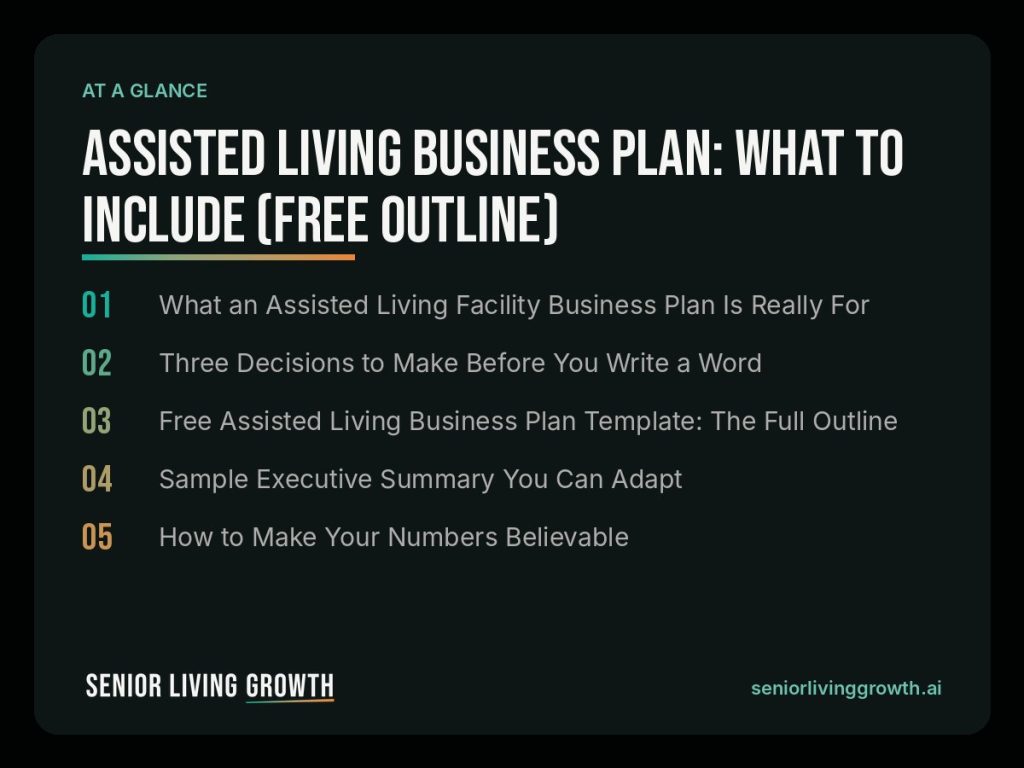
What an Assisted Living Facility Business Plan Is Really For
A business plan does three jobs. It forces you to answer hard questions before you spend money. It shows a bank or investor that you know what you’re doing. And it becomes the playbook you hand to your administrator and team.
The Small Business Administration says a traditional plan usually covers an executive summary, company description, market analysis and financial projections, and that this longer format is the one lenders and investors commonly ask for. For assisted living, you also need sections on care, licensing and staffing, because that’s where reviewers look for risk.
If you haven’t decided what kind of community to open yet, read our step-by-step guide on how to start an assisted living facility first. Then come back and build the plan.
Three Decisions to Make Before You Write a Word
Every section of your plan depends on these three answers. Write them at the top of a blank page.
- Your model. A small residential home in a house, or a larger purpose-built community? This changes your licensing, staffing, costs and how you market.
- Who pays. Private pay families only, or will you also serve residents on Medicaid? Medicaid does not cover room and board in assisted living, but many states help pay for care services through waiver programs. That changes your pricing and your paperwork.
- Build, buy or lease. Building new takes the longest. Leasing costs less up front. Buying an existing licensed community can get you open faster, with residents and staff already in place.
If buying is on the table, our free takeover checklist for new owners walks through moving the phone line, website, listings and referral partners into your name so no family’s call gets lost.
Free Assisted Living Business Plan Template: The Full Outline
Copy this assisted living facility business plan outline into a document. Each heading is a section of your plan. The bullets under it are the questions that section must answer. Write in plain sentences, and answer every bullet, even if the answer is short.
1. Executive Summary (write this last)
- Name, location and type of community (residential home or larger community).
- Number of licensed beds and the level of care you’ll offer.
- Who you serve and why they’ll choose you.
- How much money you need, what it’s for and when you expect to break even.
- Who owns it and who will run it day to day.
2. Company Description
- Legal business name, business structure and owners.
- Your mission in one or two sentences.
- The license type you’ll apply for and the state agency that issues it.
- Your timeline: key dates from today to your first move-in.
3. Services and Care
- Daily help you’ll provide: bathing, dressing, meals, medication help, laundry, housekeeping, activities.
- Care levels you will and won’t accept (for example, memory care, two-person transfers, hospice support).
- How you’ll assess a new resident and update their care plan.
- Who handles medications and what training your state requires for that.
4. Market Analysis
- Your service area: the towns or zip codes families will come from.
- Who is the typical resident, and who is the typical decision maker (often an adult child)?
- How many seniors live in your area, using public census data.
- What families in your area pay now for assisted living.
5. Competition
- List every licensed community within your service area, with size, pricing (if you can find it) and reviews.
- What families like and dislike about them, based on their reviews.
- Your clear reason to be chosen: smaller size, a specialty, location, staffing ratio or something else you can prove.
6. Marketing and Sales Plan
- How families will find you: your website, Google profile, online listings, hospital and senior care referral partners, placement agents.
- Who answers the phone, how fast, and what happens when nobody picks up.
- How you’ll give tours and follow up after each one.
- How many inquiries and tours you need each month to fill a bed.
- Your pre-opening plan: what you’ll do in the months before your license arrives.
7. Operations Plan
- A normal day, shift by shift.
- Your policies list: admissions, discharge, medication, incidents, infection control, emergencies, resident rights.
- Food service, housekeeping, maintenance and transportation.
- Vendors you’ll use (pharmacy, food, supplies) and backup plans.
8. Management and Staffing
- Who the administrator is and the training or license your state requires. (See our guide to assisted living administrator certification.)
- Your staffing plan by shift, including nights and weekends.
- Pay ranges for each role in your area.
- Hiring, background checks, training and how you’ll keep good caregivers.
9. Licensing, Insurance and Risk
- Every license, permit and inspection you need, with expected dates.
- Zoning approval for your address.
- Insurance you’ll carry, such as general liability, professional liability, property and workers’ compensation.
- Your top five risks (slow fill, staff turnover, a failed inspection) and what you’ll do about each.
10. Financial Plan
- Startup costs, line by line.
- Monthly operating costs.
- Pricing and expected revenue per resident.
- Your fill-up schedule: how many residents in month 1, 3, 6 and 12.
- A three-year profit and loss projection and a monthly cash flow for year one.
- Break-even point (how many full beds you need to cover costs).
- Funding: how much you have, how much you need and where it’s coming from.
11. Appendix
- Resumes for owners and the administrator.
- Floor plan, lease or purchase agreement, quotes from contractors and vendors.
- Letters of support from referral partners, if you have them.
Sample Executive Summary You Can Adapt
The executive summary is the first page a lender reads, so it’s worth getting right. Here’s a fill-in-the-blank version. Replace every bracket with your own facts.
[Business name] will be a [number]-bed [residential assisted living home or assisted living community] in [city, state], licensed by [state agency] as a [license type]. We will serve older adults who need help with daily tasks like bathing, dressing and medications [and memory care, if offered]. Our service area is [towns or zip codes], where [the key finding from your market research]. We will stand out by [your one clear reason to be chosen]. [Owner name] owns the business, and [administrator name], who holds [credential], will run it day to day. We are seeking [amount] to [use of funds]. Based on our fill-up schedule, we expect to reach break-even in [month] and full occupancy by [month].
Keep it to one page. If a reader only sees this page of your assisted living facility business plan, they should still understand what you’re building, who it’s for and how the money gets paid back.
How to Make Your Numbers Believable
The financial section is where most plans fall apart, and it’s the part of an assisted living facility business plan that lenders read most closely. Lots of sample plans online show big profits with no source behind them. A lender has seen those before. Build your own numbers from real quotes instead.
Startup costs
List each item and get a real quote: purchase or lease deposit, renovations, fire and safety upgrades, furniture, kitchen equipment, licensing fees, insurance, hiring and training, software and marketing. Then add working capital to cover several months of payroll and bills while you fill beds. Costs swing a lot by state, city and building, so be wary of any single national number.
Pricing
Start with what families pay nearby. For context, Genworth and CareScout’s 2024 Cost of Care Survey put the national median for assisted living at $70,800 a year. Your local number may be far higher or lower, so price from your own market research, not the national figure.
Fill-up speed
This is the number that sinks new owners. Don’t assume you’ll be full on day one. Plan month by month how many move-ins you expect, and tie each one to your marketing plan. If your plan says four move-ins a month, show the calls and tours that make that possible.
Break-even
Divide your total monthly costs by your average monthly revenue per resident. That tells you how many beds must be full just to pay the bills. Anything below that, you’re paying out of pocket.
Need help funding the gap? Read our guide to grants to open an assisted living facility, and know that many owners also look at bank loans. For example, the SBA’s 504 loan program can be used for buying, building or renovating real estate, but not for working capital.
Worked Example: The Math Behind an Assisted Living Facility Business Plan
Here’s how the numbers connect, using made-up round numbers for a small home. These are not real costs, prices or rates. They’re only here to show the math, so swap in your own.
Break-even, step by step
- Total monthly costs (payroll, rent or mortgage, food, utilities, insurance, supplies and everything else): $48,000
- Average monthly revenue per resident: $6,000
- $48,000 divided by $6,000 = 8 residents to break even
If this home had 10 beds, 8 of them would need to be full just to cover the bills. Seeing that number on paper is exactly why this section matters.
Turning move-ins into a weekly plan
Next, work backward from move-ins to the activity that creates them. Say you need two move-ins a month. The rates below are examples only, so track your real numbers and update the plan as you learn.
- If 1 in 4 tours turned into a move-in, 2 move-ins would take about 8 tours a month.
- If half of your inquiries booked a tour, 8 tours would take about 16 inquiries a month.
- That works out to roughly 4 inquiries and 2 tours every week.
Now your marketing section has a real target. Lenders like this because it ties the money to work someone will do every week.
The cash cushion
Last, compare your fill-up schedule to your break-even point. Add up the shortfall for every month you’re below break-even. That total, plus a safety margin, is the least working capital your plan should show. It’s the money that keeps payroll covered while the beds fill.
How to Present Your Plan to a Lender
A strong assisted living facility business plan still needs a strong meeting. Before you sit down with a bank, have these ready:
- The full plan, with the one-page executive summary on top.
- Your personal financial statement and tax returns, if the lender asks for them.
- Resumes for you and your administrator.
- Real quotes for renovations, furniture and equipment.
- Your licensing timeline and any letters from your state or city.
Then practice answering the questions lenders are likely to ask:
- “What happens if you fill slower than planned?”
- “Who runs the building if your administrator leaves?”
- “How much of your own money is in this?”
- “Why will families choose you over the community down the road?”
Answer with numbers from your plan, not hope. “We have six months of working capital, and we break even at eight residents” is the kind of answer that builds trust.
Residential Assisted Living Business Plan: What Changes for a Small Home
A small home of a few beds follows the same assisted living facility business plan outline, just shorter. A few sections need extra care:
- Zoning and the house itself. Check with your city early. Fire code, exits, bathrooms and accessibility upgrades can cost more than you expect.
- Staffing. With only a few residents, one caregiver calling in sick can leave you short. Show your backup plan for every shift.
- Every bed counts. One empty bed in a small home is a big share of your revenue. Your marketing section should show how you’ll keep a waiting list.
- Your own role. Many small-home owners work in the home at first. Say so, and say what your state requires of you if you’ll serve as administrator.
Don’t Skip the Marketing Section
I’ve spent more than 15 years in sales, and four of them in senior living. Here’s what I believe: a great home with a weak plan to reach families fills slowly. Families call, nobody follows up fast enough, and they tour somewhere else.
Your marketing section is the part of an assisted living facility business plan that turns empty beds into full ones. It should name the channels, the people responsible and the weekly numbers you’ll track. For a full walkthrough, see our senior living marketing plan guide. You can also grab the free Weekly Lead Tracker and Missed-Call Text Back templates so your plan has real tools behind it from day one.
Keep the Plan Alive After You Open
A business plan isn’t a document you write once for the bank and forget. Once you’re open, it becomes your scorecard.
- Monthly: compare real move-ins, inquiries and tours to the fill-up schedule in your plan.
- Monthly: compare real costs to your budget, line by line, and note anything more than a little off.
- Every quarter: update your pricing research and your list of competitors.
- Every year: rewrite the financial plan for the year ahead using what you actually learned.
When the numbers drift, you’ll see it early, while there’s still time to fix it.
Common Business Plan Mistakes to Avoid
- Copying a sample plan’s numbers instead of using your own quotes.
- Skipping your state’s rules. Licensing, staffing and administrator rules vary by state, so read your state’s assisted living regulations before you finish the plan.
- Planning for full occupancy on opening day.
- Leaving out working capital.
- Writing a marketing plan that says “word of mouth” and nothing else.
Your assisted living facility business plan doesn’t need fancy words. It needs honest numbers, a clear picture of the care you’ll give and a real plan to reach families. Use the outline above, fill in every bullet and update it as you learn. When it’s done, you’ll know if this business works on paper before you bet your savings on it.
Keep reading
- How to Run a Senior Living Tour That Ends in a Move-In
- The Assisted Living Move-In Checklist Families Will Thank You For
- More new owner guides on the blog
FAQ
How long should an assisted living business plan be?
There’s no required length. A plan for a larger community going to a lender will be long and detailed, while a plan for a small residential home can be much shorter. What matters is that every section answers its questions clearly.
Is there a free assisted living business plan template?
Yes. The full assisted living facility business plan outline in this article is free to copy. Paste it into a document and fill in each section with your own details and numbers.
What do lenders look for in a business plan for assisted living?
Lenders want realistic startup costs, a believable fill-up schedule, enough working capital and an experienced administrator. They also want to see that your assisted living facility business plan shows you understand your state’s licensing rules and have a plan to reach families.
How often should I update my business plan?
Check your real numbers against the plan every month once you’re open, and do a full update at least once a year. Update it sooner if something big changes, like a new competitor, a price change or a shift in staffing costs.
Do I need a business plan to buy an existing facility?
Yes, especially if you’re borrowing money. Your plan should show the current residents, staff and finances, plus what you’ll change after the sale. Our new owners checklist covers the handoff steps.