If you searched for grants to open an assisted living facility, you were probably hoping to find free money with your name on it. Here is the honest answer: for most people opening a for-profit assisted living home, that free money does not exist.
That is not bad news. It just means the real path runs through loans, partners and a strong plan. This guide shows which grants are real, who can actually get them, how most owners pay for their first building, and how to spot the scams that target new owners.
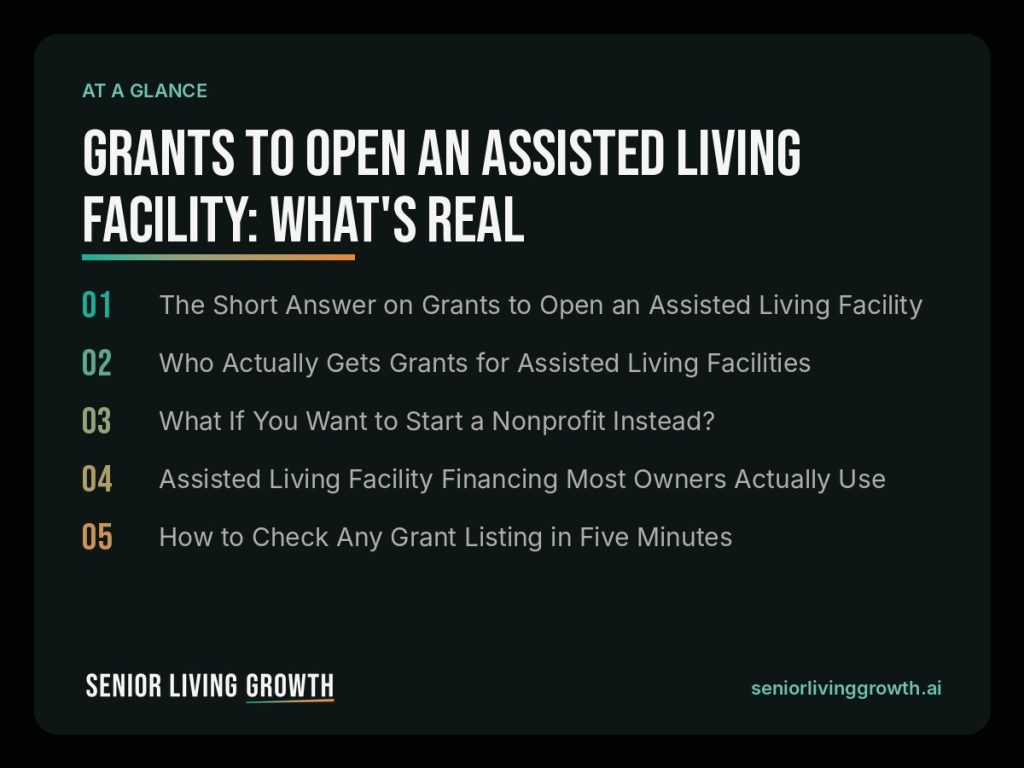
The Short Answer on Grants to Open an Assisted Living Facility
Real grants for assisted living facilities do exist. But almost all grants to open an assisted living facility go to one of these groups:
- Cities, counties and other public bodies
- Community-based nonprofits
- Federally recognized tribes
- Owners of existing government-assisted senior housing who are adding care services
If you are one person or a small company planning to open a for-profit home, you will most likely pay for it with loans, your own cash and maybe investors. The U.S. Small Business Administration says it plainly on its own grants page: it does not provide grants for starting or expanding a business.
Knowing this early saves you months of chasing programs you can’t use. Now let’s look at what is actually out there.
Who Actually Gets Grants for Assisted Living Facilities
USDA Community Facilities grants (rural, public or nonprofit)
This is the program people mean most often when they say “assisted living grant.” USDA Rural Development’s Community Facilities Direct Loan and Grant Program helps build essential community buildings in rural towns, and its list of eligible health care facilities includes nursing homes and assisted living facilities.
Here is the catch. Only public bodies, community-based nonprofits and federally recognized tribes can apply. USDA also says the program does not cover private, commercial or business projects. The town must be rural, with no more than 20,000 residents.
The grant only pays part of the cost. The share depends on how small the town is and how low local incomes are. The highest level is up to 75% of eligible costs, and that is only for the smallest, lowest-income towns. Most projects that qualify mix grant money with a USDA loan. Applications go through your state’s Rural Development office, which accepts them all year.
If you are a nonprofit, town or tribe
If your group does qualify for Community Facilities, here’s a simple way to start:
- Call your state’s Rural Development office and describe the project before you write anything.
- Ask whether your town fits the population and income rules, and roughly what share of the cost a grant could cover.
- Ask what a loan and grant mix would look like, since most projects use both.
- Gather your board records, a project budget and real quotes, the same as you would for a bank.
The staff there can tell you early whether the project is a fit, which saves a long application that goes nowhere.
HUD’s Assisted Living Conversion Program
HUD has offered grants to help existing senior apartment buildings add assisted living. But past funding notices limited this to private nonprofit owners of HUD-assisted senior housing, like older Section 202 buildings. Privately owned assisted living facilities were not eligible. Funding also depends on what Congress approves each year, so it is not always open.
State and local programs
Some states, counties and cities have money for senior housing or small businesses. These programs vary a lot. They are often tied to affordable housing, residents on Medicaid, rural areas or creating local jobs. Many are loans, not grants.
To find what exists where you live, check with:
- Your state’s economic development office
- Your state housing finance agency
- Your local Small Business Development Center (free help, funded in part by the SBA)
- Your state’s Rural Development office, if you are in a small town
Private foundations
Foundations do give money in senior care. But they mostly fund nonprofits for specific programs, like dementia support or caregiver training. It is rare for a foundation to pay a new owner’s startup costs.
What If You Want to Start a Nonprofit Instead?
Some founders look at that list and think, “Then I’ll start a nonprofit.” That can be a real path, especially for a mission-driven project in a rural or low-income area. But it is a different kind of business.
A nonprofit has a board, strict rules about money and no owner in the usual sense. You don’t build personal equity the way you would with a for-profit home. Talk to an attorney and a CPA before you go this route, and make sure it fits your goals, not just the grant.
Assisted Living Facility Financing Most Owners Actually Use
If none of the grants to open an assisted living facility fit your project, you are in good company. For a for-profit owner, assisted living facility financing usually means a loan plus a down payment. Here are the main options.
SBA loans (7(a) and 504)
When people talk about an SBA loan for assisted living, they mean one of two programs. In both, the SBA does not lend you the money directly. It backs part of a loan made by a lender, which makes the lender more willing to say yes.
- SBA 7(a) loans are the flexible option. The SBA lists uses like buying or improving real estate, working capital, equipment, furniture and buying an existing business. The SBA lists the maximum 7(a) loan at $5 million.
- SBA 504 loans are for big fixed assets: land, buildings, renovations and long-life equipment. They come through Certified Development Companies working with a bank. They can’t be used for working capital.
To qualify, your business must operate for profit, meet SBA size rules and show it can repay. In 2026 the SBA announced that borrowers can combine 7(a) and 504 loans for up to $10 million in total. Limits and rules change, so always ask your lender for current numbers.
USDA Business and Industry loan guarantees (rural)
Unlike the Community Facilities grant, this USDA program does allow for-profit businesses. USDA backs part of a loan your bank makes, for projects in rural areas outside cities of more than 50,000 people. USDA says most types of businesses are eligible but some industries are restricted, so ask your state Rural Development office whether your project fits.
HUD Section 232 (FHA-insured loans)
Section 232 is not a grant either. It is mortgage insurance from FHA for nursing homes, assisted living facilities and board and care homes. It can be used to buy, refinance, build or substantially rehab a building. The loan comes from an FHA-approved lender, and HUD insures it. The application is detailed and lender-driven, so talk to an approved lender early if you think it may fit.
Conventional bank loans
A local bank or credit union may lend on the real estate, especially if you have a strong down payment, good credit and experience in care. Community banks that already lend to health care businesses are often the best first call.
Seller financing
If you are buying an existing home, the seller may agree to carry part of the price and let you pay them over time. This can lower what you need from a bank. If you go this way, plan your takeover carefully. Our free takeover checklist for new owners walks you through moving the phone line, website, Google profile and referral relationships into your name so no family’s call gets lost.
Investors and partners
Many first-time owners bring in a partner who adds cash, credit strength or care experience. Put every agreement in writing with an attorney before money changes hands.
How to Check Any Grant Listing in Five Minutes
When you find a program that looks promising, don’t start the application yet. Check these five things first. They’ll tell you quickly whether it’s one of the real grants to open an assisted living facility that you can actually use, or one to skip.
- Who can apply. Every federal funding notice has a section that defines who is eligible. Grants.gov warns that applying when you aren’t eligible wastes your time and money. Look for whether for-profit businesses or small businesses are listed. If they aren’t, stop there.
- What the money can pay for. Many programs fund a specific service or project, not buildings, furniture or startup costs.
- Where the project must be. Rural programs set population limits. USDA Community Facilities, for example, is limited to towns of 20,000 people or fewer.
- Whether you must match it. Some grants pay only part of the cost and expect you to cover the rest. Know how much you’d need to bring.
- The deadline and the contact. Check the closing date, then reach out to the program contact on the notice with any question the notice doesn’t answer.
If the “grant” comes from a website, caller or social media message instead of the agency itself, go straight to the scam checklist below.
Common Mistakes When Searching for Grants to Open an Assisted Living Facility
- Paying for grant lists. The official list of federal grants is free on Grants.gov.
- Skipping the eligibility section. A for-profit applying to a nonprofit-only program gets turned down, no matter how good the project is.
- Waiting on a grant before talking to lenders. Months can pass. Talk to banks and your local Small Business Development Center at the same time.
- Counting a grant before it’s awarded. Lenders won’t treat hoped-for money as real. Show that your plan works without it.
- Forgetting the strings. Grant money usually comes with rules on how it’s spent and reported. Read them before you accept.
- Starting a nonprofit only to chase a grant. As covered above, that changes who owns and controls the business.
How to Spot a Grant Scam
People searching for free money to start a business, including grants to open an assisted living facility, are a favorite target for scammers. The Federal Trade Commission and Grants.gov both warn about the same red flags:
- Someone contacts you first. The government does not reach out to award grants you never applied for.
- They ask for a fee. The government does not charge a fee to apply for a federal grant. Don’t pay for a “list of grants” either.
- They want strange payment methods. Gift cards, wire transfers, cash reload cards and crypto are scam signs.
- They ask for your bank or Social Security number by phone, text, email or social media.
- The promise sounds too easy. Real grants take an application and serve a specific purpose.
The official list of federal grants is free at Grants.gov. If you think you’ve been targeted, you can report it at ReportFraud.ftc.gov.
Worked Example: Funding a Small Home Without a Grant
Here’s a made-up example to show how owners often combine funding when grants aren’t an option. The numbers are invented and rounded on purpose. Your lender sets the real terms.
Say a first-time owner wants to buy and update a small licensed home, and the full project costs $900,000. That includes the purchase, safety upgrades, furniture and several months of working capital. Here’s one way it could come together:
- Owner cash: $100,000 from savings
- Partner: $50,000 from a business partner who also brings care experience
- Seller financing: $100,000 that the seller agrees to carry and be paid back over time
- Bank loan with an SBA guarantee: $650,000 for the rest, including working capital
Every lender has its own rules about how much cash you must put in and whether a seller note counts toward it, so ask about this early.
Notice what’s missing: a grant. The project still came together because of a clear plan, real quotes and a lender who believed the home would fill.
That’s the lesson for anyone searching for grants to open an assisted living facility. Your time is usually better spent making your plan easy for a lender to say yes to than hunting for free money.
Build the Plan Every Lender Wants to See
Whether you apply for a loan, bring in a partner or qualify for a grant, everyone asks for the same proof. They want to know your idea will work.
That means a real business plan with startup costs, monthly expenses, how fast you’ll fill beds and how you’ll pay the loan back. If you haven’t written one yet, start with our guide to building an assisted living business plan. For the full roadmap, from licensing to opening day, see how to start an assisted living facility.
I tell every new owner the same thing: lenders care about your census plan as much as your building. Show them how families will find you, how you’ll answer every call and how you’ll follow up after tours. Our free templates, like the Weekly Lead Tracker and Missed-Call Text Back, give you a simple system you can point to in that plan.
The Bottom Line
Grants to open an assisted living facility are real, but they are built for nonprofits, public bodies and specific rural or affordable housing projects. If you are opening a for-profit home, plan on assisted living loans, a down payment and a solid plan. Skip anyone who wants a fee to “find” you free money, and put that energy into a plan a lender will love.
Keep reading
- How to Become a Certified Assisted Living Administrator
- How to Build a Senior Living Marketing Plan (Free Template)
- How to Run a Senior Living Tour That Ends in a Move-In
- More new owner guides on the blog
FAQ
Can I get a government grant to start a for-profit assisted living facility?
It is very unlikely. Most grants to open an assisted living facility are not open to for-profit owners. The main federal programs that fund assisted living buildings, like USDA Community Facilities, are limited to public bodies, nonprofits and tribes. Most for-profit owners use SBA, USDA, HUD-insured or bank loans instead.
Does the SBA give grants for assisted living facilities?
No. The SBA says it does not provide grants for starting or expanding a business. It does back loans through lenders, including 7(a) and 504 loans that can help pay for real estate, equipment and, with 7(a), working capital.
What is the best loan to open an assisted living facility?
It depends on your project. SBA 7(a) loans are flexible, SBA 504 loans fit buildings and land, USDA guarantees can help in rural areas, and HUD Section 232 is built for licensed care facilities. Talk to a few lenders and compare terms before you choose.
Can a nonprofit get a grant to open assisted living?
Possibly. Nonprofits, public bodies and tribes are the main groups eligible for grants to open an assisted living facility, such as USDA Community Facilities in rural towns. Even then, grants usually cover only part of the cost, so plan on loans or other funding too.
How can I tell if a grant offer is real?
Real federal grants, including any grants to open an assisted living facility, are listed for free on Grants.gov, and the government never charges a fee to apply. If someone contacts you out of the blue, asks for a fee or wants your bank details, treat it as a scam.