Opening a place where older adults feel safe and cared for is one of the most meaningful businesses you can build. It’s also one of the most regulated. If you want to know how to start an assisted living facility the right way, the order of your steps matters as much as the steps themselves.
This guide shows how to start an assisted living facility one step at a time, from choosing your model to filling your first beds. One warning up front: rules change from state to state, so treat this as your map and your state’s licensing agency as the final word.
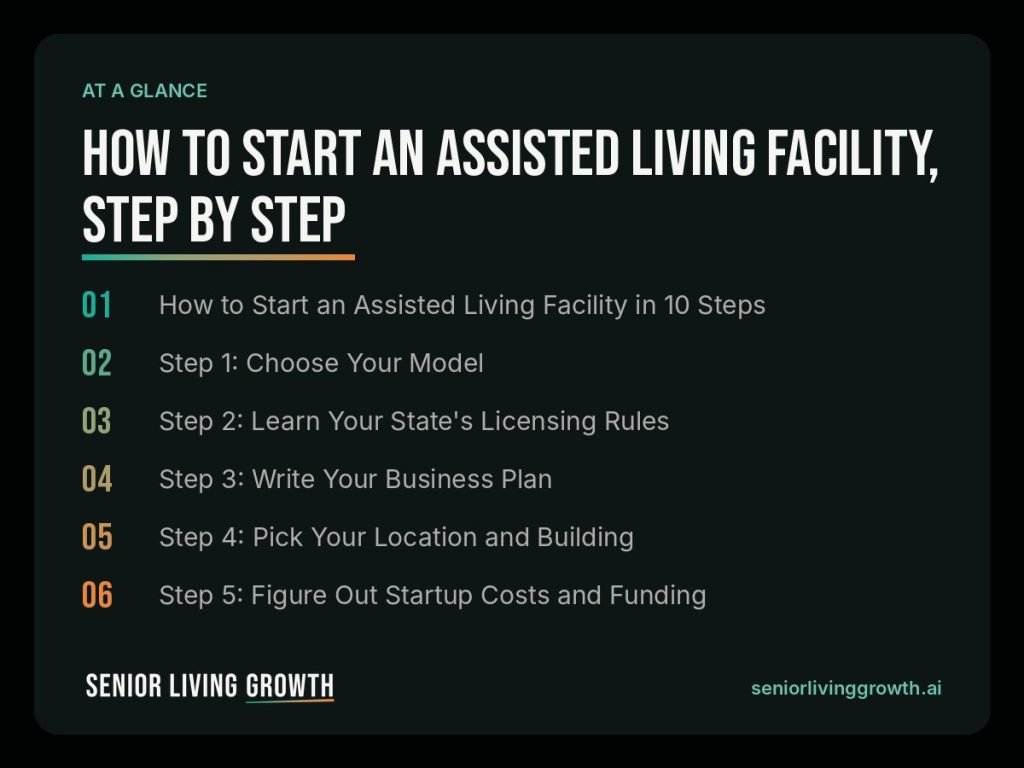
How to Start an Assisted Living Facility in 10 Steps
Here’s the short version. Each step is explained below.
- Choose your model.
- Learn your state’s licensing rules.
- Write your business plan.
- Pick your location and building.
- Figure out startup costs and funding.
- Plan your staffing and administrator.
- Write your policies.
- Get the right insurance.
- Start marketing before you open.
- Fill your first beds.
If you’ve been searching for how to open an assisted living facility, these are the same steps. The order is what keeps you from paying rent on a building you can’t use yet.
Step 1: Choose Your Model
There are two main ways to start an assisted living business, and they’re very different.
A small residential home
This is a regular house set up to care for a small number of residents. Costs are lower, it feels like home, and families often love the small staff-to-resident ratio. The tradeoff: every empty bed hurts, and staffing a 24-hour home with a small team is hard.
A larger assisted living community
This is a purpose-built or converted building with many apartments, a dining room, activities and a bigger team. It costs far more to build and fill, usually needs outside investors or large loans, and takes longer to open.
Or buy one that’s already open
Buying an existing licensed community is a third path. You may get residents, staff and a reputation on day one. If that’s your plan, our new owners takeover checklist shows how to move the phone line, website, listings and referral relationships into your name without losing a single call.
Most first-time owners start with a small residential home. If that’s you, the rest of this guide covers how to start a residential assisted living home too.
Step 2: Learn Your State’s Licensing Rules
Licensing is where much of the real work in how to start an assisted living facility happens. There is no single national license for assisted living. Each state writes its own rules, and even the names differ. A federal review of every state’s rules found that most states use the term “assisted living,” many also use “residential care,” and many have more than one license category.
To compare states, the National Center for Assisted Living publishes a yearly state-by-state review of assisted living rules, covering topics like the licensing agency, staffing and training. It’s a helpful overview, but your own state’s current regulations are the final word.
For example, Colorado calls them “assisted living residences” and licenses them through its state health department. Other states call them personal care homes, adult care homes or residential care facilities.
Here’s how to find your rules:
- Search “[your state] assisted living license” and look for a website ending in .gov. It’s usually the state health department or human services department.
- Download the actual regulations, not just a summary. Read the sections on staffing, medication, building safety and resident rights.
- Call the licensing office. Ask how to apply, how long it takes, what inspections are required and whether there’s an orientation class for new owners.
- Ask your city about zoning before you buy or lease anything.
Licensing usually starts with an application or letter of intent, then inspections before you can accept residents. Build that wait into your timeline.
Questions to ask on your first call to the licensing office
If you’re serious about how to start an assisted living facility, this call is one of the most useful things you can do in your first week. Ask these questions word for word:
- “Which license type fits a home with [number] residents who need help with [bathing, medications, memory care]?”
- “Is there a required orientation or class for new applicants?”
- “What are the steps, in order, from application to my first resident?”
- “Which inspections happen before I open, and who does them: your office, the fire marshal or the city?”
- “What are the application and license fees?”
- “What does the administrator need, and when must they be in place?”
- “Are there limits on how many residents I can serve in a house like the one I’m looking at?”
- “How long are applications taking right now?”
Take notes, and ask where each answer is written in the rules. Rules on paper beat your memory of a phone call.
Step 3: Write Your Business Plan
The business plan is where learning how to start an assisted living facility turns into real numbers. Before you sign a lease or apply for a loan, put your idea on paper. Your plan covers your services, market, competition, staffing, marketing and numbers. It’s also what lenders will ask for.
We wrote a full guide with a free outline you can copy: assisted living business plan: what to include. Do this step before you spend money, not after.
Step 4: Pick Your Location and Building
Where you open shapes everything else. Look for:
- Demand. Plenty of older adults and adult children nearby, and not too many similar homes already.
- Zoning approval. Your city must allow care homes at that address.
- A building that can pass inspection. Think exits, fire safety, bathrooms, door widths, ramps and room sizes. Your state’s rules set the details.
- Easy access. Close to hospitals, doctors and pharmacies, and easy for families to visit.
Get a contractor who knows your state’s care home rules to walk the building with you before you commit. Upgrades like sprinklers and accessible bathrooms can change your budget fast.
Step 5: Figure Out Startup Costs and Funding
Assisted living startup costs vary more than almost any other number in this guide. A small home in a low-cost area and a new 60-unit building are worlds apart. Instead of trusting a national estimate, build your own list:
- Purchase price or lease deposits
- Renovations and safety upgrades
- Furniture, beds, kitchen and laundry equipment
- Licensing and permit fees
- Insurance
- Hiring and training before opening
- Software, phones and your website
- Marketing before you open
- Working capital to cover payroll and bills for several months while you fill beds
Get real quotes for each line. Then look at how you’ll pay for it: your own savings, a partner or investor, bank or SBA-backed loans, and sometimes grants. Our guide to grants to open an assisted living facility explains what’s realistic.
Also decide who will pay you. Medicaid does not pay room and board in assisted living, though many states help cover care services through waiver programs. If you want to serve Medicaid residents, ask your state what extra steps are required.
Step 6: Plan Your Staffing and Administrator
Every state requires someone to be in charge of daily operations, usually called the administrator or manager. Training rules vary widely by state, and some states require a separate administrator license or exam.
Read our guide on assisted living administrator certification to learn what to look for, then confirm your state’s exact rules with its licensing office.
For the rest of your team, plan for:
- Caregivers on every shift, including nights and weekends.
- Someone trained to handle medications the way your state requires.
- Background checks. Most states require them for administrators and caregivers, often with fingerprints.
- Required training hours before staff work with residents, plus yearly training.
- A backup list for call-outs. In a small home, one missed shift is a big problem.
Step 7: Write Your Policies
Your state will expect written policies, and inspectors will ask to see them. Common ones include:
- Admissions and who you can and can’t serve
- Resident assessments and care plans
- Medication handling
- Incidents, falls and reporting
- Infection control
- Emergencies and evacuation
- Resident rights and complaints
- Move-out and discharge
Use your state’s regulations as your checklist. Each rule should point to a policy that explains how you follow it.
Step 8: Get the Right Insurance
Talk to an insurance agent who works with care homes. Coverage owners often look at includes general liability, professional liability, property coverage and workers’ compensation once you have employees. Your state, landlord or lender may require certain types and amounts, so ask each of them in writing.
Step 9: Start Marketing Before You Open
This is the step that people learning how to start an assisted living facility most often leave too late. Families often take weeks or months to decide. If you start marketing the day your license arrives, you’ll be paying staff for empty beds.
Start a few months before opening:
- Claim your Google Business Profile and build a simple website with photos, your phone number and a way to book a tour.
- Get listed on the senior living directories families use in your area.
- Meet hospital case managers, home health agencies, hospice teams and placement agents. Bring something useful, not just a brochure.
- Make sure every call gets answered, and every missed call gets a text back within minutes.
- Start a waiting list and keep in touch with everyone on it.
You don’t have to write these messages from scratch. Our free templates include a Missed-Call Text Back, a Voicemail Greeting Script, Three Follow-Up Messages and a Referral Partner Thank-You you can copy today.
Step 10: Fill Your First Beds
Your first residents set the tone. Their families will write your first reviews and tell their friends. Here’s what I tell anyone opening a home: treat every inquiry like it’s your only one, because early on, it might be.
- Respond fast. Call back the same day, every time.
- Give a great tour. Show the rooms, introduce the staff and ask about the person who’d be moving in, not just the budget.
- Follow up. Most families won’t decide on the first visit. Send a thank-you the same day and check in over the following week.
- Ask for reviews. Once families are happy, ask them to share it online.
- Thank your referral partners. Let them know how the person they sent is doing, within privacy rules.
What to say when the first families call
Being new isn’t a weakness if you’re honest about it. Try something like this:
“Thanks so much for calling. We’re a new [number]-bed home in [town], and we’re welcoming our first residents now. Can I ask who you’re calling about and what’s going on?”
Then listen, answer their questions plainly and book a tour before you hang up.
Track every lead in one place so nothing slips. When you’re small, a simple sheet like our free Weekly Lead Tracker is plenty.
A Sample Timeline for How to Start an Assisted Living Facility
Every state and building moves at its own pace, so this timeline uses phases instead of dates. What matters is that each phase is done before the next one starts costing you money. In some states, parts of these phases overlap, so follow the order your licensing office gives you.
- Research. Read your state’s rules, call the licensing office, study your local market and talk with a few people who run care homes. No big spending yet.
- Plan and fund. Write the business plan, get real quotes and line up financing. Don’t sign a lease or purchase agreement until zoning and licensing look workable for that address.
- Secure the building. Sign, then start renovations and safety upgrades with a contractor who knows your state’s care home rules.
- Apply and prepare. Submit your license application, write your policies, hire your administrator and key staff, and start marketing.
- Inspect and open. Pass the required inspections, receive your license, train your team and welcome your first residents.
Marketing should start in phase four at the latest. Families take time to decide, so the earlier they know you’re coming, the better.
Common Mistakes New Owners Make
Most of these mistakes come from doing the right steps in the wrong order. Watch for them as you work out how to start an assisted living facility in your state.
- Signing for a building before checking zoning. If the city won’t allow a care home there, you’re stuck with a property you can’t use.
- Underfunding working capital. Beds fill slowly, and payroll starts before revenue does.
- Copying policies from the internet. Generic policies may not match your state’s rules, and inspectors will notice. Write each one from your own regulations.
- Hiring the administrator last. An experienced administrator can help you set up policies, staffing and inspection prep. Bring them in early if you can.
- Saying yes to every resident. Accepting someone whose care needs go beyond your license or your staff puts them and you at risk. Know your limits and write them into your admissions policy.
- Waiting to market until the license arrives. Empty beds cost money every single day.
- Going it alone. Your local Small Business Development Center offers free business advising, and people who already run homes are often happy to share what they learned.
Putting It All Together
Starting an assisted living business takes patience. If you remember one thing about how to start an assisted living facility, make it the order: learn your state’s rules first, write a real plan, pick a building that can pass inspection, hire carefully and start reaching families long before opening day. Do those in order, and you give yourself the best chance of opening with a full calendar of tours.
Keep reading
- How to Build a Senior Living Marketing Plan (Free Template)
- How to Run a Senior Living Tour That Ends in a Move-In
- More new owner guides on the blog
FAQ
How long does it take to open an assisted living facility?
It depends on your state, your building and whether you’re renovating or building new. Licensing alone involves applications and inspections that can take months. Ask your state licensing office for current timelines before you set an opening date.
How much does it cost to start an assisted living business?
Startup costs vary widely by state, city, building size and whether you buy, lease or build. A small residential home costs far less than a large community. Get local quotes for each item and add several months of working capital.
Do I need a license to open a residential assisted living home?
In most cases, yes. Colorado, for example, requires a license once a home offers room, board and personal care to three or more adults who aren’t related to the owner. Other states set different size limits and license names, so check with your state health or human services department before you accept anyone.
What is the first step in how to start an assisted living facility?
Read your state’s licensing rules and call the licensing office before you spend money on a building. That one step tells you which license fits, what the building must meet and what your administrator needs. Everything else in your plan builds on it.
Do I need healthcare experience to open an assisted living facility?
Rules for owners vary by state, so check yours. Every state requires someone responsible for daily operations, and most require training for caregivers. If you’re new to care, hiring an experienced administrator is one of the smartest moves you can make as you figure out how to start an assisted living facility.